The Step That Determines Whether Anything Else Lasts
Mold is a symptom. It is the visible consequence of water being somewhere it should not be for longer than it should have been there. Remove the mold without removing the water and you have performed an expensive cleaning that buys you one seasonal cycle, usually less.
This is the most common way mold projects fail in this region, and it almost never looks like failure at the time. The drywall comes out, the framing is cleaned, new board goes up, the room looks excellent. Fourteen months later there is a stain in the same corner. Nothing was done wrong in the remediation. The diagnosis was never made.
Ask any contractor quoting you: “Where is the water coming from, and how do you know?” A real answer sounds like “the downspout at the northeast corner discharges eighteen inches from the wall, the grading falls back toward the house there, and I have elevated moisture readings on the interior of that wall for eleven feet in both directions from the corner.” A non-answer sounds like “it's the humidity” or “these old houses are always damp.”
The Six Ways Water Gets Into a Montgomery County House
Almost every case resolves to one of these, and the diagnostic approach differs for each.
1. Bulk water intrusion from outside
Rain, surface runoff and groundwater physically entering the structure. Signature: it correlates with rainfall. It appears within hours of a storm and it is worst after prolonged rain rather than a brief downpour.
Usual culprits in this housing stock: gutters overflowing or disconnected; downspouts discharging within a few feet of the foundation; grading that has settled over decades so the ground now slopes toward the house; window wells without drainage that fill and overtop; deteriorated mortar joints in stone and block foundations; a failed or absent exterior damp-proof coating; a hydrostatic pressure problem under the slab where groundwater rises; and sump systems that are undersized, have a failed check valve, or discharge too close to the building and simply recirculate the same water.
2. Capillary rise through masonry
Distinct from bulk intrusion and frequently confused with it. Water is drawn upward through porous masonry by capillary action against gravity. The signature is different: it is constant rather than storm-correlated, it is worst at the base of the wall and diminishes with height, and it is very commonly accompanied by efflorescence — the white crystalline bloom left when water carrying dissolved salts evaporates at the surface.
This is the defining moisture mechanism in the region’s historic building stock. Fieldstone foundations in Gulph Mills, Valley Forge, Wayne and Villanova, and the stone and brick cellars of Norristown and Conshohocken, were built before any concept of a damp-proof course existed. There is no membrane between the footing and the wall and there never was. The wall is permanently connected to the ground water table by capillary action, and it always will be. The strategy for these buildings is management rather than elimination — vapour-open finishes, no trapped assemblies, and dehumidification — which is a very different conversation from sealing a modern poured wall.
3. Interior condensation on cold surfaces
No leak involved. Warm humid air contacts a surface below its dew point and deposits liquid water. This is the largest single category of mold-causing moisture in this climate and the one most often misdiagnosed as a leak, because homeowners reasonably assume that water means a hole.
Where it happens: buried foundation walls in summer; the rim joist; uninsulated cold water supply lines, which can drip continuously through July; toilet tanks in humid bathrooms; ductwork running through unconditioned space with damaged or missing insulation; the back of exterior wall sheathing in winter; the underside of roof decking in winter; and the interior face of windows and metal window frames. Diagnosis requires surface temperature measurement and dew point calculation, which is why a hygrometer and an infrared thermometer are as important to this work as a moisture meter.
4. Plumbing failure
Supply line pinholes, drain leaks, failed wax rings under toilets, shower pan failures, appliance supply hoses, and water heater tanks. Signature: it is not correlated with weather, it is usually localised around a fixture or a pipe run, and the moisture often appears on the floor below rather than at the source.
Two failure modes are particularly relevant to the older housing in Norristown, Bridgeport, Conshohocken and the pre-war Main Line: galvanised steel supply piping, which corrodes from the inside and eventually perforates, and cast-iron drain stacks, which corrode at the bottom of the run and leak into the cellar for years before anyone notices. Both are original to a great many homes built before 1960 and both are well past their service life.
5. Roof, flashing and ice damming
Signature: storm-correlated, and it appears at the ceiling or at the top of a wall. The complication is that water entering at a roof penetration travels along rafters and top plates and can emerge many feet from its entry point, which is why chasing a ceiling stain upward in a straight line often finds nothing.
Ice damming deserves its own mention because it is a mixed-climate phenomenon absent from most national guidance. Heat escaping into the attic melts snow on the upper roof; the meltwater runs down to the cold eave beyond the heated envelope and refreezes; the resulting ice ridge dams subsequent meltwater, which backs up under the shingles and enters the structure at the eave. The damage is at the top plate and in the wall cavity below, and because it happens in February and often does not stain visibly until the following summer, it is one of the most under-diagnosed mold causes in older Montgomery County housing.
6. Mechanical system condensate
An air conditioning system removes a surprising volume of water from the air — commonly several gallons a day in humid weather — and all of it has to go somewhere. Blocked condensate drain lines, failed condensate pumps, corroded or improperly pitched drain pans, and missing secondary pans are a routine cause of ceiling and wall damage below air handlers, especially where the unit sits in an attic or a closet on an upper floor. High-efficiency condensing furnaces produce condensate too, and their drains block in exactly the same way. See air duct and HVAC mold cleaning.
How the Diagnosis Is Actually Made
- Timeline interviewWhen did it start, does it correlate with rain, with the seasons, with the heating or cooling season, with use of a particular fixture? The pattern narrows the field before any instrument comes out. This step is free and it is frequently the most informative.
- Moisture mappingSystematic pinless metering to define the wet area precisely, then pin readings to confirm depth and true moisture content. The shape of the wet zone is diagnostic: a downward plume indicates a source above, a band along the base indicates rising damp, an even field across a whole wall indicates condensation.
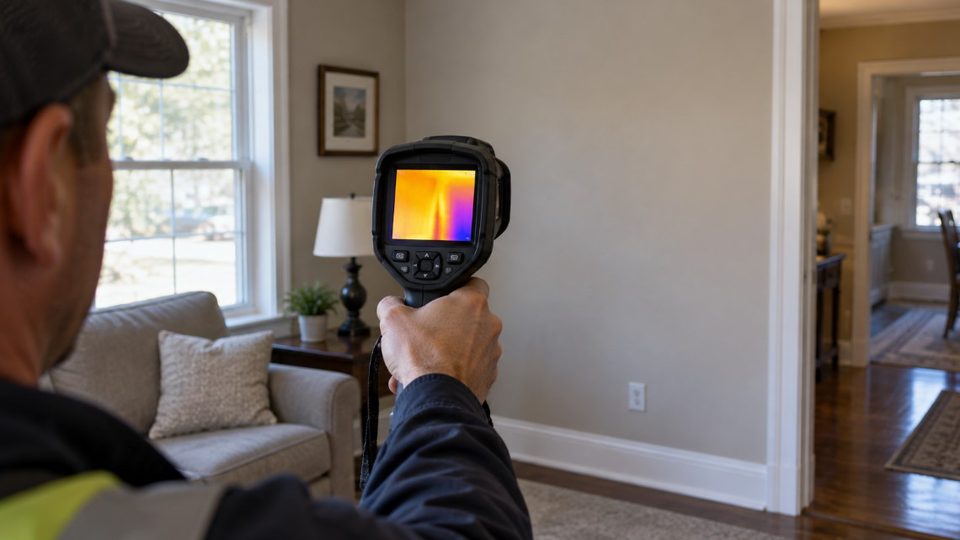
- Thermal imagingReveals temperature anomalies that point to concealed wet material, missing insulation and air leakage paths. Always confirmed with a meter, never relied on alone.
- Dew point analysisAir temperature and relative humidity give the dew point; an infrared thermometer gives the surface temperature. If the surface is colder, it is condensing. This single calculation resolves a large fraction of cases.
- Water testingWhere a specific suspicion needs confirming: running a hose on a section of roof or wall, flooding a shower pan and leaving it, or running a specific fixture while monitoring below.
- Exterior water management surveyGrading within ten feet, downspout discharge, gutter condition, window wells, patio and driveway slope, and where the sump actually discharges. Often the whole answer.
- Borescope or inspection openingWhere the evidence points into a closed assembly, a small camera port settles it. Better a pencil-diameter hole now than a full wall opened on the wrong side of the room.
Reading the Signature
| What you observe | Most likely source |
|---|---|
| Damp only after heavy rain, dries within days | Bulk intrusion — grading, gutters, downspouts, window wells |
| Constantly damp at the base of the wall, white crystalline bloom | Capillary rise through masonry |
| Wet in July, dry in January, no leak found | Summer condensation on cold foundation or rim joist |
| Stain appears in spring on a ceiling near an outside wall | Winter ice damming at the eave |
| Localised damp near one fixture, unrelated to weather | Plumbing supply or drain leak |
| Ceiling damp below an attic or closet air handler in summer | Condensate drain or pan failure |
| Dripping pipes in a basement in August | Condensation on uninsulated cold supply lines |
| Dark staining on attic sheathing, worst on the north plane | Ventilation imbalance or a bath fan terminating in the attic |
| Whole basement damp and musty with no localised wet spot | Ambient humidity — inadequate or absent dehumidification |
A meaningful share of chronic basement moisture in Montgomery County is resolved by three things that cost very little: clearing the gutters, extending every downspout to discharge at least six feet from the foundation, and correcting negative grading in the first ten feet around the house. Before anyone quotes you for interior waterproofing or a French drain, do these and observe for a season. A contractor who will tell you to do that first is one worth keeping.
Frequently Asked Questions
In most cases the source can be identified without demolition, using moisture mapping, thermal imaging and dew point analysis, supported by a timeline interview and an exterior survey. Where the evidence points firmly into a closed assembly, a borescope port — a hole roughly the diameter of a pencil, typically placed low on a wall behind the future baseboard or inside a closet — usually settles it. Full exploratory demolition is a last resort, and a contractor who reaches for it first is guessing at your expense.
Almost certainly not. That is the classic signature of summer condensation, and it is the most common basement moisture mechanism in this climate. From June to September, regional dew points sit in the mid-60s to low 70s. Your buried foundation wall sits around 52 to 58 degrees. Humid air reaching that wall is already below its dew point and gives up liquid water directly onto the masonry. A leak does not behave seasonally in that pattern. The fix is not waterproofing — it is closing the space to outdoor air and running a correctly sized dehumidifier plumbed to a drain.
No. That is almost certainly efflorescence — mineral salts left behind when water passes through masonry and evaporates at the inside face. It is crystalline, it brushes off as powder, and it will dissolve in water. Mold is filamentous, tends to be fuzzy or slimy rather than crystalline, and is usually green, black, grey or brown rather than white. But efflorescence is not good news: it is direct physical proof that liquid water is moving through that wall. It tells you the mechanism is active even where mold has not yet established.
In this market it is usually bundled into a full mold inspection, which generally runs $300 to $700 for a typical single-family home. A standalone moisture investigation on a specific, well-defined problem — one wall, one ceiling stain — is often $200 to $450. Complex cases requiring water testing, multiple visits in different weather, or extensive borescope work run higher. These are general planning ranges. It is almost always the best money spent on the whole project, because it is the only part that determines whether the rest works.
That is common, particularly in older homes, and it is one of the main reasons DIY diagnosis goes wrong. A Norristown twin might simultaneously have capillary rise at the base of a stone cellar wall, summer condensation on the rim joist, and a slow cast-iron drain leak — three different mechanisms producing what looks like one damp basement. Fixing one and finding the dampness persists leads people to conclude the fix did not work, when in fact it worked on a third of the problem. A methodical inspection distinguishes them by their signatures and prioritises them by severity.