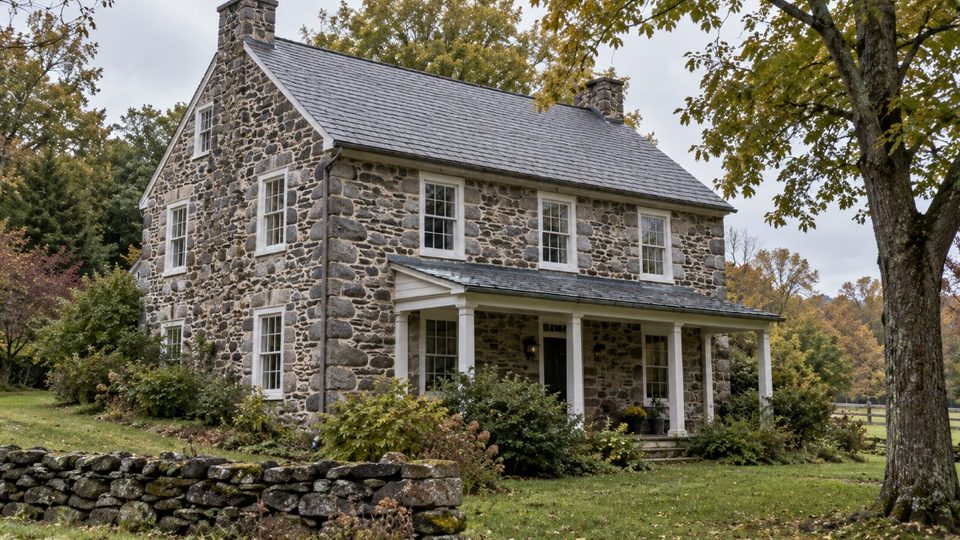
One of the Oldest Planned Suburbs in America, and It Shows
Wayne sits across Radnor, Tredyffrin and Easttown Townships in the 19087 ZIP, and it is one of the defining Main Line communities. Its character comes from the 1880s, when the railroad suburb was developed as a planned residential community — substantial Victorian houses on generous lots, laid out along tree-lined streets, followed by successive waves of Colonial Revival, Tudor Revival and Arts and Crafts building through to the 1930s, and then by mid-century and modern infill.
The result is a housing stock of exceptional quality and considerable age, and the mold problems here are almost entirely the problems of old buildings that have been continuously modernised.
Where the Moisture Actually Comes From in a Wayne House
1. Concealed plumbing failures — the leading cause
Houses of this era commonly retain original galvanised steel supply piping and cast-iron drain stacks, sometimes partially replaced and sometimes not. Galvanised pipe corrodes from the inside out and eventually perforates; cast iron corrodes at the base of the run and leaks into the cellar. A slow supply leak inside a plaster wall can run for months or years without any visible sign, and it produces exactly the sustained saturation that Stachybotrys requires. When we are called to a Wayne house with dark growth and no obvious cause, this is where it usually leads.
2. Cellars with no damp-proof course
Pre-1930 foundations have no capillary break. Water moves upward through the masonry continuously. Efflorescence at the base of the wall, constant rather than rain-correlated dampness, and staining that diminishes with height are the signature. Manageable with exterior water control and dehumidification; made considerably worse by interior waterproof coatings and by framing insulated walls against the stone.
3. Complex roofs
Victorian and Revival rooflines have many more junctions than modern ones: multiple gables, dormers, valleys, turrets, porte-cocheres, porch roofs meeting main walls, and slate or tile in some cases. Every junction is a flashing detail and every flashing detail eventually fails. They also generate many ice dam locations — valleys and low porch roofs collect meltwater that refreezes at cold edges and backs up under the covering. Because ice dam damage occurs in February and frequently does not stain visibly until the following summer, it is routinely misdiagnosed as a summer roof leak.
4. Finished third floors and dormer voids
Where a third floor or attic has been finished, there are almost always unconditioned voids behind the kneewalls and around the dormers. Warm air leaks in from the heated rooms and condenses on cold sheathing. These spaces are rarely inspected and frequently contaminated.
5. Additions and renovation junctions
Most Wayne houses have been extended or substantially renovated, sometimes repeatedly. The junction between original construction and an addition is a recurring problem area: differential settlement opens gaps, flashing between old and new is often imperfect, and materials with different vapour behaviour meet in ways nobody designed. Look at these junctions first.
6. Modern improvements applied to old fabric
This is worth stating plainly because it causes so much of the damage we see. Repointing stone with Portland cement mortar forces moisture out through the face of the stone, spalling it. Impermeable paint on lime plaster traps moisture and blisters. Spray foam applied directly to the underside of old roof sheathing without addressing the ventilation strategy can trap moisture against the wood. Sealing a historically vapour-open building without understanding how it dries is the most common way a well-intentioned renovation creates a mold problem.
Lead, Asbestos and Historic Fabric
Practically every pre-1940 house in Wayne is a pre-1978 building, which means lead paint is likely and asbestos is common — in pipe lagging, floor tile, mastic, textured finishes and duct insulation. These carry obligations separate from the mold work and they need to be identified before demolition, not during it.
Beyond the regulatory point, there is a conservation one. A great deal of what makes these houses valuable is original fabric: plaster, millwork, flooring, windows, stonework. Remediation that treats the interior as disposable destroys value that cannot be rebuilt. Removal should be as surgical as the contamination allows, plaster should be repaired in plaster rather than patched in drywall, and masonry should be repaired with lime. This requires a contractor who has worked on buildings like this before, and in this region there are good ones precisely because there is so much of this housing stock.
What an Assessment Should Cover Here
- Systems inventory firstSupply piping material, drain stack material and age, roof age and covering, whether the cellar has ever been coated or finished, and where every addition meets the original structure.
- Moisture-map around all plumbing runsWalls backing bathrooms and kitchens, the base of drain stacks, and the cellar ceiling beneath wet rooms. The highest-yield survey in this housing.
- Read the cellarEfflorescence height and pattern, joist ends bearing into masonry, anything furred out against the wall, and whether dampness is constant or storm-correlated.
- Trace the roof geometry downEvery valley, dormer and porch junction, then the top plate and ceiling in the rooms below. Check the eaves for ice dam evidence.
- Open the third floor and dormer voidsRarely inspected, frequently the answer.
- Test for lead and asbestos before any demolitionFew hundred dollars in advance; a stopped job if discovered midway.
- Specify conservation-appropriate repairLime mortar, plaster in plaster, vapour-open finishes, surgical removal.
What We Get Called About Most in Wayne
Ranked by how often it comes up, and tied to the buildings that are actually here rather than to mold in general.
- Concealed plumbing failures inside plasterThe single most common cause in Wayne's housing. Original galvanised and cast-iron systems are decades past service life, and a leak inside a plaster wall can run for months with no visible sign at all.
- Flashing failures on estate-era roofsEvery valley, dormer, chimney and porch junction is a detail that eventually fails — and water entering at the roof travels along rafters and emerges far from its entry point.
- Ice damming at low eaves and porch roofsFebruary water entry at the top plate that does not stain visibly until the following summer, by which point nobody connects the two.
- Modern improvements applied to old fabricCement repointing, impermeable paint over lime plaster, spray foam applied to old roof sheathing without resolving the ventilation strategy first. Well-intentioned, and the cause of most of the damage we see.
- Voids behind finished third floorsLarge houses have a great deal of space nobody enters. Warm air leaks in, condenses on cold surfaces, and nothing is observed for years.
Neighborhoods and Sections We Cover in Wayne
Mold Services Available in Wayne
Mold Inspection
Thermal imaging and moisture metering to locate the source before anything is opened up.
DetailsBasement Mold Removal
The dominant mold problem in Wayne — finished walls, stone foundations and sump failures.
DetailsBlack Mold Removal
Full containment for water-damage indicator species, plus finding the sustained water source.
DetailsAttic Mold Removal
Sheathing and rafter growth traced back to ventilation, bath fans or ice damming.
DetailsWater Damage & Flood Mold
Burst pipes, sump failures and flooding — the 24 to 48 hour response window.
DetailsClearance Testing
Independent verification by a hygienist who did not perform the remediation.
DetailsWhat Mold Work Costs in Wayne
General market ranges for the Greater Philadelphia area, listed for the situations that actually come up in Wayne. These are planning figures rather than quotes — nobody can price a job they have not seen, and what moves a number most is the size of the wet area rather than the stained area. The full cost guide explains what drives each one up or down.
| Work | Typical range | Notes |
|---|---|---|
| Mold inspection with thermal imaging and moisture metering | $300–$700 | Most projects should start here |
| Small contained area — one wall section, a closet, behind a water heater | $600–$1,800 | Under roughly 10–30 sq ft |
| Historic stone cellar, lime-based repair | $4,000–$12,000 | Specialised materials; often less demolition |
| Single room | $1,500–$4,500 | Containment, removal, drying, clearance |
| Lead and asbestos testing before demolition (pre-1978 building) | $400–$1,200 | Far cheaper in advance than discovered mid-job |
| Independent post-remediation clearance testing | $350–$700 | The only stage that produces evidence rather than assurance |
| Reconstruction after remediation | $25–$60 / sq ft | Quote this separately so you can compare bids |
Mold FAQ — Wayne, PA
In a house of that age the most likely answer by a wide margin is a concealed plumbing failure — original galvanised supply pipe that has perforated, or a corroded cast-iron drain. Stachybotrys and similar water-damage indicator organisms need cellulose saturated for a week or more, which rules out condensation and points firmly at a liquid water source running for a long time. The other candidates are a roof or flashing leak tracking down inside the wall from a valley or dormer above, and ice dam water entering at the eave. A proper investigation moisture-maps the wall to find the extent, works upward to find the origin, and checks the plumbing runs behind it. Do not let anyone start cleaning before that is established.
It can be done well and it can go badly, and the difference is whether the whole moisture strategy was thought through. Applying closed-cell foam directly to old roof sheathing converts a vented attic into an unvented conditioned one, which is a legitimate approach but changes how the roof assembly dries. If there is any existing leak, or if the sheathing is already damp, the foam traps moisture against wood you can no longer see or inspect. In a house with a complex old roof and a history of flashing repairs, that is a genuine risk. Before agreeing: have the roof assessed and any leak resolved, confirm the sheathing moisture content is at target, and get the contractor to explain in writing how the assembly dries and what happens if a leak develops later.
These properties vary more than most, so the ranges are wide. General market planning figures: inspection roughly $400 to $1,000 given size and complexity. A contained single-area remediation, roughly $1,500 to $5,000. A concealed plumbing leak that has saturated a wall assembly over months, commonly $8,000 to $25,000 because the wet area is extensive and plaster repair is more involved than drywall. Cellar remediation with historically appropriate repair, roughly $5,000 to $15,000. Lead and asbestos testing before demolition, roughly $400 to $1,200. Conservation-grade repair adds meaningfully to reconstruction cost and is generally worth it in this market.
Ask directly about historic experience and ask for specific addresses of comparable work. The questions that separate the two kinds of contractor: will you repair plaster in plaster or patch in drywall; what mortar will you use on the masonry; how will you protect original millwork and flooring during containment; and how do you decide what to remove versus clean? A contractor who answers those confidently has done this before. One who talks only about demolition scope has not. This region has a great deal of historic housing and there are genuinely good specialists working in it — it is worth waiting for the right one rather than taking the first available.
Slate itself is excellent and long-lived; the failures are almost always in the accessories rather than the slate. What fails: the flashing at valleys, chimneys and dormers, which is usually copper or lead and eventually corrodes or lifts; the nails and battens holding the slate, which fail long before the slate does, causing slipped tiles; and the underlayment, which on an original roof is long past its life. Water entering at a slipped slate or a failed valley flashing travels along rafters and can emerge many feet away, which is why chasing a ceiling stain straight upward often finds nothing. Slate roofs also generate ice dams readily at valleys and low porch roofs. Have the roof assessed by a slate specialist rather than a general roofer — the repair methods are genuinely different.