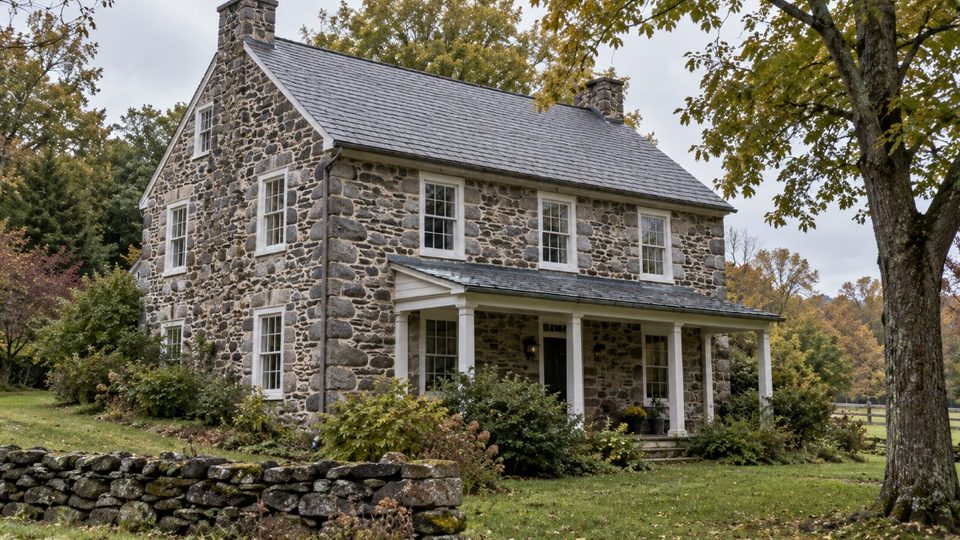
An Old Mill Village With Old Mill Village Problems
Gulph Mills is one of the oldest settled parts of Upper Merion, and its name tells you what it was: a milling settlement on Gulph Creek, on the old Gulph Road that ran between Philadelphia and the Schuylkill Valley. The Continental Army passed through and camped here in December 1777 on the march to Valley Forge. The stone buildings scattered through the village and along the surrounding roads date from that era and the century that followed.
That history is precisely why mold work here is different from work a mile away in the postwar sections of King of Prussia. These are masonry buildings on a creek valley floor, built before damp-proofing existed, sitting on ground that holds water.
The Creek Valley Is the Whole Story
Gulph Creek cuts a steep, narrow valley through this part of Upper Merion before running down to the Schuylkill. That topography produces three distinct moisture problems that overlap in the same small area.
A high water table on the valley floor. Properties on the low ground near the creek sit close to groundwater. Basements and cellars there are in more or less permanent contact with saturated soil, and they behave accordingly — not dramatically, but constantly.
Flash flooding in the corridor. A steep, narrow valley collects runoff fast. Heavy rain produces rapid rises in the creek and surface water moving through the low ground. This is a different phenomenon from Schuylkill riverine flooding — it is quicker, more localised and more frequent.
Hillside water on the slopes. Properties on the valley sides have the opposite problem: groundwater moving laterally downslope through the soil and through fractures in the underlying schist, arriving at the uphill foundation wall under pressure. This produces seepage that appears on one wall only, is worst after prolonged rain rather than a brief downpour, and is often blamed on the wrong thing entirely. Correct handling is exterior — interception and diversion of the water upslope — rather than sealing the inside face.
Historic Stone Construction: How It Works and How It Is Broken
The eighteenth and nineteenth century stone buildings of Gulph Mills were built of local fieldstone and Wissahickon schist laid in lime mortar, on rubble footings, with no damp-proof course. Water is drawn up through the foundation continuously by capillary action. It always has been and it always will be.
These buildings survived because they were vapour-open: soft lime mortar, lime plaster, limewash or nothing at all on the interior face. Moisture entering the wall evaporated harmlessly from the inside. The whole assembly moderated moisture rather than resisting it.
The damage we are called to nearly always comes from modern intervention:
- Portland cement repointing. The single most destructive common practice on this building stock. A cement joint is harder and much less permeable than the stone around it, so moisture that used to leave through the soft joint is forced through the face of the stone, which spalls. The correct material is lime mortar, matched to the original.
- Interior waterproof coatings. Cementitious or elastomeric products applied to the inside face of a cellar wall do not prevent water entering — they prevent it leaving. The trapped water then blows the coating off, spalls the masonry, or migrates sideways and upward to find another exit.
- Studded and insulated basement walls. Framing against the stone with fiberglass and paper-faced drywall creates a cold, dark, sealed, permanently damp cavity with a cellulose food source in it. This is the worst thing that can be done to one of these cellars, and it is done frequently.
- Modern impermeable paint on lime plaster. Same mechanism upstairs. Blistering paint on an old plaster wall is usually trapped moisture, not bad paint.
- Exterior water management first — gutters, downspouts discharging well away, grading, and interception of hillside water upslope
- Lime-based mortar and plaster for any repair, matched to the original
- Vapour-open interior finishes throughout; no sealed cavities against the stone
- Open, ventilated storage in cellars — nothing tight against the wall, nothing cardboard on the floor
- Mechanical dehumidification set to 45–50%, running April through October
- Accepting that the cellar will be cool and slightly damp, and managing it rather than attempting to defeat it
The Other Gulph Mills Housing
Not everything here is colonial. The area includes substantial mid-century and later housing on the slopes and plateau above the creek — postwar Capes and ranches, 1960s and 1970s split-levels and colonials, and later infill. These carry the standard Upper Merion pattern: kneewall attic cavities in the Capes, partially below-grade finished lower levels in the splits, degraded original foundation waterproofing, bath fans of uncertain termination, and where basements were finished in the 1980s and 1990s, the stud-wall-and-fiberglass assembly that fails reliably.
Properties on the hillside above the creek also have the lateral groundwater issue described above, which is frequently the actual cause of a “basement leak” that no amount of interior sealing has resolved.
Pre-1978 Buildings: Lead and Asbestos
Worth flagging specifically because so much of the housing here predates 1978. Any building from before that year may contain lead paint, and buildings from before roughly 1980 frequently contain asbestos in pipe lagging, floor tile, mastic, textured finishes and duct wrap. Disturbing either during mold remediation or reconstruction carries legal and safety obligations entirely separate from the mold work. Testing before demolition costs a few hundred dollars; discovering it midway through a job costs considerably more and stops the work.
What We Get Called About Most in Gulph Mills
Ranked by how often it comes up, and tied to the buildings that are actually here rather than to mold in general.
- Lateral groundwater on the valley sidesWater soaks into the hillside above, moves downslope through soil and schist fractures, and arrives at the uphill foundation wall under pressure. It appears on one wall only and only after prolonged rain — and sealing the inside face will not stop it.
- Cement repointing on eighteenth-century stoneThe single most destructive common practice on this building stock. A cement joint is harder and far less permeable than the stone, so moisture exits through the stone face instead and spalls it, slowly and irreversibly.
- Flash flooding in the Gulph Creek corridorA steep narrow valley produces rapid creek rises in heavy rain — a quicker, more frequent and more localised phenomenon than Schuylkill riverine flooding.
- Cellars furred out against the stoneFraming, fiberglass and drywall installed against a wall that is permanently drawing groundwater. The worst concealed mold we are called to in this area is in exactly this assembly.
Neighborhoods and Sections We Cover in Gulph Mills
Mold Services Available in Gulph Mills
Mold Inspection
Thermal imaging and moisture metering to locate the source before anything is opened up.
DetailsBasement Mold Removal
The dominant mold problem in Gulph Mills — finished walls, stone foundations and sump failures.
DetailsBlack Mold Removal
Full containment for water-damage indicator species, plus finding the sustained water source.
DetailsAttic Mold Removal
Sheathing and rafter growth traced back to ventilation, bath fans or ice damming.
DetailsWater Damage & Flood Mold
Burst pipes, sump failures and flooding — the 24 to 48 hour response window.
DetailsClearance Testing
Independent verification by a hygienist who did not perform the remediation.
DetailsWhat Mold Work Costs in Gulph Mills
General market ranges for the Greater Philadelphia area, listed for the situations that actually come up in Gulph Mills. These are planning figures rather than quotes — nobody can price a job they have not seen, and what moves a number most is the size of the wet area rather than the stained area. The full cost guide explains what drives each one up or down.
| Work | Typical range | Notes |
|---|---|---|
| Mold inspection with thermal imaging and moisture metering | $300–$700 | Most projects should start here |
| Historic stone cellar, lime-based repair | $4,000–$12,000 | Specialised materials; often less demolition |
| Small contained area — one wall section, a closet, behind a water heater | $600–$1,800 | Under roughly 10–30 sq ft |
| Unfinished basement clean, treat and dehumidify | $1,500–$5,000 | Where there is no finished wall assembly to remove |
| Lead and asbestos testing before demolition (pre-1978 building) | $400–$1,200 | Far cheaper in advance than discovered mid-job |
| Independent post-remediation clearance testing | $350–$700 | The only stage that produces evidence rather than assurance |
Mold FAQ — Gulph Mills, PA
That is the signature of lateral groundwater movement on a slope, which is common on the valley sides around Gulph Creek. Water soaks into the hillside above you, moves downslope through the soil and through fractures in the underlying schist, and arrives at your uphill foundation wall under hydrostatic pressure. It takes prolonged rain rather than a brief downpour because the ground has to saturate first. The important implication: sealing the inside face of that wall will not work, because the water is arriving under pressure from outside. The effective fixes are exterior — intercepting and diverting the water upslope with a curtain drain, correcting grading, and managing roof discharge — possibly combined with an interior drainage system to a sump as a secondary measure.
No, and this genuinely matters more than almost anything else you will do to the building. Portland cement mortar is harder and far less permeable than the fieldstone and schist around it. Once the joints are cement, moisture that used to evaporate harmlessly through the soft lime joint is forced to exit through the face of the stone instead, which spalls and progressively destroys it. The damage is slow, cumulative and effectively irreversible. Use lime mortar matched to the original in strength and permeability. There are masons in this region with genuine historic experience — there is a great deal of this building stock in Chester and Montgomery County — and it is worth seeking one out rather than accepting a general mason's standard mix.
Partly, and partly not, and it is worth distinguishing. A cool, slightly damp cellar with some efflorescence on the stone is behaving normally for a building of this age and construction. A musty odour, though, means active fungal growth producing microbial VOCs — something down there is wet enough to support it. Common culprits in these cellars: cardboard boxes and stored paper on a damp floor, wooden shelving in contact with the wall, old carpet or matting, joist ends where they bear into the masonry, and anything furred out against the stone. The realistic goal is not a dry cellar — it is a cellar with nothing in it that can support growth, plus dehumidification. That usually eliminates the smell entirely.
Parts of the low ground along Gulph Creek are exposed to flash flooding, which is a different and more frequent phenomenon than Schuylkill riverine flooding. A steep narrow valley collects runoff quickly, so heavy rain produces rapid creek rises and surface water moving through the valley floor. Properties on the slopes and the plateau above generally are not in a mapped flood zone but often have the lateral groundwater problem instead. Check the specific property against the FEMA flood map, and if you are buying, ask directly about water history — including during the September 2021 Ida event, which produced record flooding across the region.
Usually somewhat, though not because the mold is worse. Three factors add cost: the repair materials are specialised, since lime mortar and vapour-open plaster are not what a general contractor keeps on the truck; pre-1978 buildings may require lead and asbestos testing before any demolition; and access is often harder, with low cellars, irregular stonework and tight stairs. The offsetting factor is that these buildings frequently need less demolition, since there is less drywall and fiberglass to remove and stone and lime plaster are far more tolerant of wetting than modern materials. A realistic planning range for a historic cellar remediation here is $3,000 to $10,000, with repair specification driving most of the variation.