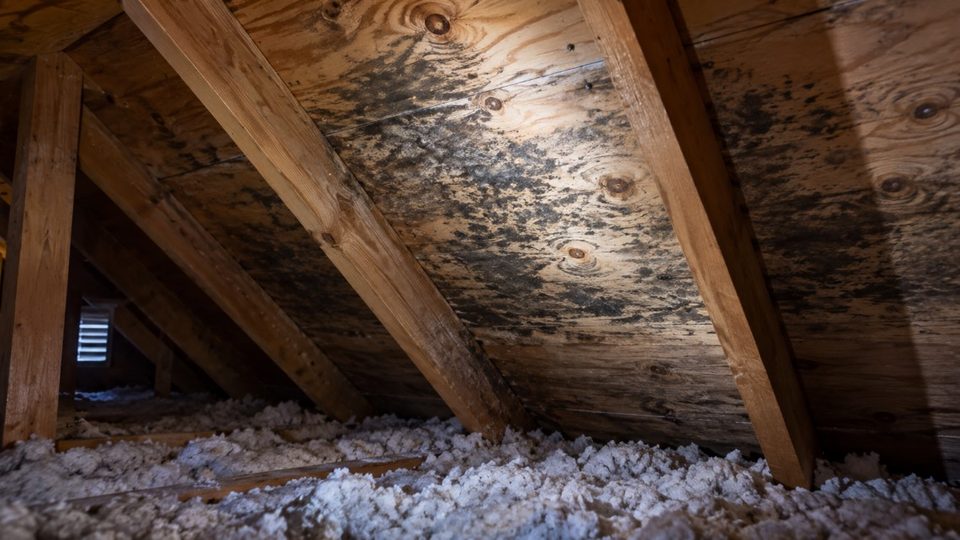
Attic Mold Is Always a Symptom of Something Below It
Mold on attic sheathing looks like an attic problem. It almost never is. In nearly every case the water came from the living space underneath — warm, humid indoor air leaking upward into a cold attic and condensing on the underside of the roof deck. Fix the staining without fixing that, and it returns within a winter or two.
This is a cold-climate and mixed-climate phenomenon, which is why generic national mold advice handles it so badly. In southeastern Pennsylvania, with real winters and roughly 17 inches of average annual snowfall, the conditions for attic condensation and for ice damming both exist, and both are common in the region’s older housing.
The Five Causes, in Order of How Often We See Them
1. Air leakage from the house into the attic
The dominant cause. Every penetration through the ceiling plane is a path for warm, humid indoor air to rise into the attic: recessed light fixtures, the attic access hatch, plumbing vent stacks, electrical wiring holes, bathroom fan housings, chimney chases, and the top plates of interior walls. In winter that air carries household moisture — from showering, cooking, laundry and breathing — up to meet roof sheathing that may be at 20°F. It condenses instantly, and in very cold weather it forms frost on the underside of the deck which then melts and soaks the wood during a thaw.
The signature is diagnostic: staining concentrated around specific penetrations, or generally across the sheathing but worst on the north-facing plane, which stays coldest.
2. Bathroom exhaust fans terminating in the attic
Extremely common in this housing stock, and very often the whole explanation. A bath fan moves shower moisture out of the bathroom and, in a great many homes, discharges it straight into the attic through a flexible duct that ends in mid-air, or through a duct that has fallen off its roof or gable termination, or through one that was never connected at all. The result is a plume of warm saturated air delivered directly at cold sheathing, every day, for years.
The signature is a distinct dark cone or halo on the sheathing directly above the bathroom. If you see localised heavy staining in an otherwise clean attic, go and find where the bath fan duct actually ends. Dryer vents discharging into an attic produce the same picture and are even worse, because a dryer moves far more water.
3. Inadequate or unbalanced ventilation
A vented attic works by continuous airflow from low intake at the soffits to high exhaust at the ridge. Both halves are required. What commonly goes wrong: insulation blown in during an energy upgrade has covered the soffit vents and nobody installed baffles; soffit vents are painted shut or blocked by debris; there is ridge venting but no soffit intake, so the ridge vent pulls air from inside the house instead of from outside; or the roof has a mixture of incompatible vent types — ridge vents plus powered fans plus gable vents — which short-circuit each other so air moves between the vents rather than across the deck.
The signature is generalised staining across the sheathing, typically worst near the ridge where warm moist air accumulates.
4. Ice damming
The mixed-climate special case, and the one most often missed because the damage does not appear where the ice was. Heat escaping into the attic warms the roof deck and melts snow on the upper roof. The meltwater runs down and reaches the eave, which extends beyond the heated envelope and is genuinely cold, and there it refreezes. The resulting ice ridge dams the next round of meltwater, which pools behind it and backs up under the shingles, because asphalt shingles shed water flowing downhill and are not waterproof to standing water.
The water then enters at the eave and soaks the top plate of the exterior wall, the ends of the rafters, the wall cavity below, and often the ceiling. The signature is staining concentrated at the eaves and at the top of exterior walls in upstairs rooms — and critically, it frequently does not become visible until the following spring or summer, by which point nobody connects it to February. The low-eave, moderate-pitch geometry of the region’s 1940s and 1950s Cape Cods makes them particularly susceptible.
5. Roof leaks and flashing failure
The cause everybody assumes and the least common of the five. A genuine roof leak produces localised staining that traces back to a specific penetration — a plumbing boot, a chimney, a valley, a skylight, a satellite mount. The complication is that water entering at the roof travels along rafters before dropping, so the stain below can be several feet from the actual entry point.
Reading Your Own Attic
| What the staining looks like | Most likely cause |
|---|---|
| A distinct dark cone or circle above a bathroom | Bath fan discharging into the attic |
| General staining, worst near the ridge | Ventilation imbalance — usually blocked soffit intake |
| General staining, notably worse on the north slope | Air leakage from the house; north plane stays coldest |
| Staining concentrated along the eaves, and ceiling stains in upstairs rooms at exterior walls | Ice damming |
| Dark ring around a specific penetration | Air leakage at that penetration, or a flashing leak there |
| A single localised patch traceable to a pipe boot or chimney | Roof leak or flashing failure |
| Staining on the backs of kneewalls in a Cape Cod | Air leakage into the unconditioned kneewall triangle |
| Frost on the nails or sheathing in deep winter | Active condensation happening right now |
Remediation, and the Part That Actually Matters
- Diagnose before cleaningDetermine which of the five causes applies. Clean first and you will be back. Check where every bath fan and dryer duct terminates — physically follow them.
- Contain and protectSeal the attic hatch, protect the living space below, and set up HEPA-filtered negative air. Attic work generates a great deal of airborne material and the ceiling penetrations are exactly the path into the house.
- Remove contaminated insulationBlown-in or batt insulation that has been wetted or heavily contaminated is removed and bagged. This is often the bulk of the labour.
- Clean the sheathing and framingHEPA vacuuming followed by mechanical cleaning. For heavy staining on sheathing, soda blasting or dry-ice blasting are the usual methods — they remove the growth and most of the discolouration without the water that wire brushing and chemical scrubbing introduce.
- Treat, then encapsulate if wantedAntimicrobial on cleaned surfaces. A clear or white encapsulant is optional and cosmetic; it also makes future inspection easier by giving a clean reference surface. It is not a substitute for cleaning.
- Correct the actual cause — the essential stepAir-seal every ceiling penetration with fire-rated foam or caulk. Duct bath fans and dryers to the exterior through the roof or a gable, with insulated duct and a proper damper. Install baffles and clear the soffit intake. Balance the ventilation, removing conflicting vent types. Where ice damming is the cause, air sealing plus increased insulation at the eaves plus an ice and water membrane at the next roof replacement.
- Re-insulate correctlyNew insulation to current depth, with baffles maintaining a clear air channel from soffit to ridge, and the attic hatch insulated and weatherstripped.
There is a substantial trade in cheap attic mold treatment — usually a chemical spray and a white coating, quoted attractively, often generated off the back of a home inspection report during a real estate transaction. It makes the attic look clean in photographs. If nobody has traced where the bath fan terminates or checked whether the soffits are blocked, it has changed nothing about why the mold grew. Before accepting any attic quote, ask what the contractor believes the moisture source is and how they established it.
Does Attic Mold Affect the Air in the House?
Less than most homeowners fear, and more than nothing. Air generally moves upward from the living space into the attic during the heating season, which means the attic is downstream rather than upstream for much of the year — the opposite of a crawl space. That is genuinely reassuring.
The qualifications: during summer, when a hot attic and air conditioning below can reverse or complicate the pressure relationship, and where ductwork or an air handler is located in the attic — which is common in this region — the connection becomes direct. A leaky return duct in a contaminated attic draws attic air into the supply and distributes it through the house. Disturbing the attic, by storing or retrieving boxes, also pushes material down through the hatch. And attic mold frequently coincides with an air leakage problem, which by definition is a connection between the two spaces.
Frequently Asked Questions
Because the water almost certainly came from inside the house rather than from outside it. Warm, humid indoor air leaks upward through gaps in the ceiling — recessed lights, the attic hatch, plumbing stacks, wiring holes, the tops of interior walls — and condenses on roof sheathing that may be at 20°F in January. Add a bathroom fan discharging into the attic instead of through the roof, which is very common in this housing stock, and you have a moisture source delivering saturated air at a cold surface every day. Genuine roof leaks are the least frequent of the five causes, not the most.
It is rarely urgent in the way a flooded basement is urgent. Because air generally moves from the living space up into the attic during the heating season, attic mold usually has limited direct impact on the air you breathe — the important exceptions being where ductwork or an air handler sits in the attic, or where the attic is used for storage and regularly disturbed. What makes it worth addressing on a sensible timescale is the structural and financial side: sustained wetting degrades sheathing and framing, and unaddressed attic mold is a reliable deal complication when you come to sell, which in this market is a real cost.
General market ranges for this area: cleaning and treatment of a small to moderate area, roughly $1,500 to $4,000. Full attic remediation including insulation removal, soda or dry-ice blasting of the sheathing, treatment and re-insulation, roughly $3,500 to $9,000. Ventilation correction — baffles, soffit clearing, ridge vent installation — typically $800 to $3,500 on top. Rerouting bath fans to proper exterior terminations, roughly $400 to $1,200 per fan. Ceiling-plane air sealing, roughly $1,000 to $3,000. Sheathing replacement, where decay has gone that far, is a roofing job and priced accordingly. Planning ranges, not quotes.
Not as the whole job, no. Encapsulation applied over uncleaned growth seals contamination in place under a coating — it hides it rather than removing it, and if the moisture source is still active the growth continues underneath. Encapsulation has a legitimate role after the surface has been properly cleaned: it locks down any residual staining and gives you a clean reference surface that makes any future recurrence obvious. So the order is clean, treat, then encapsulate if you want to, and always after the moisture source is corrected. See mold encapsulation.
Very probably, and this is one of the most under-recognised patterns in older Montgomery County housing. Ice damming pushes water back under the shingles at the eave, where it soaks the rafter ends, the top plate of the exterior wall and often the wall cavity and ceiling below. Because that happens in February and the material dries slowly inside a closed assembly, the mold and the staining frequently do not become visible until the following summer — by which time nobody connects it to the ice. If you had visible ice dams and you are now seeing staining at the eaves, at the top of upstairs exterior walls, or on upstairs ceilings near the outside wall, treat those as the same event. The lasting fix is air sealing the ceiling plane and improving insulation at the eaves, because ice dams are caused by heat loss, not by weather.