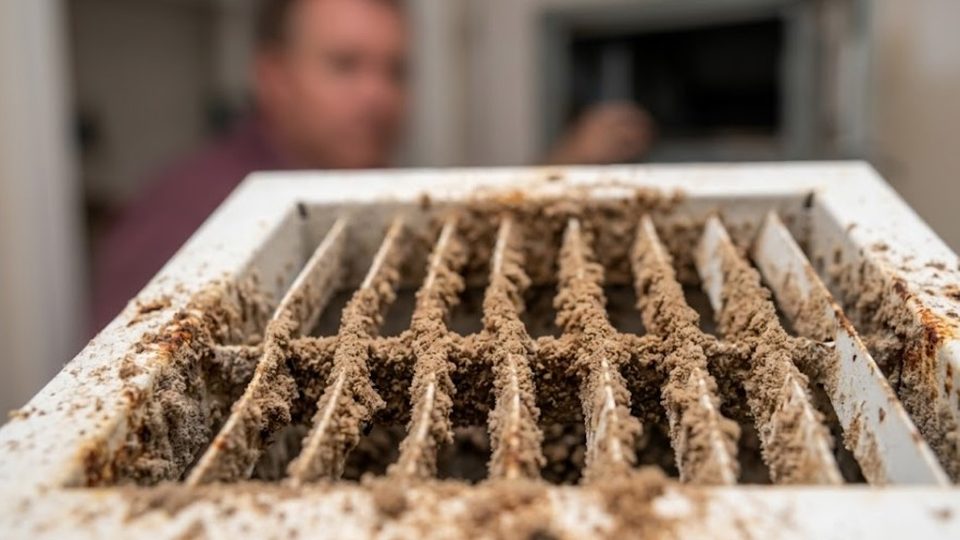
Ten Minutes, a Torch, and a Ladder
This is the highest-value DIY diagnostic available to a Montgomery County homeowner, and almost nobody does it.
A bathroom exhaust fan is supposed to take shower moisture out of the bathroom and discharge it outside the building — through the roof or through a gable wall, with a proper terminating hood and a backdraft damper. In a great many homes in this region, particularly unmodernised postwar housing, it does not.
Instead the duct ends in the attic. Or it once connected to a roof termination and has fallen off. Or it was crushed under insulation and is blocked. Or, in older houses, there is no duct at all — the fan simply blows into the attic by design, which was acceptable practice at one time.
The result is that every shower delivers a plume of warm, saturated air directly at cold roof sheathing, every day, for as long as the house has been standing.
Why It Does So Much Damage
A single shower releases on the order of half a litre to a litre of water into the air. Two showers a day, every day, is somewhere between three and seven litres a week going into your attic.
In January, that saturated air meets sheathing at perhaps 20°F. It condenses instantly, and in cold enough weather it forms frost on the underside of the deck and on the nail points, which then melts during a thaw and soaks the wood. In summer it adds humidity to a space that is already hot and poorly ventilated.
The signature is unmistakable once you know it: a distinct dark cone or halo of staining on the sheathing directly above the bathroom, in an attic that is otherwise reasonably clean. If you see localised heavy staining in one area of an otherwise unremarkable attic, go and find the bath fan duct.
A clothes dryer moves far more water than a bathroom fan — several litres per load. A dryer duct that has become disconnected in a basement, crawl space or attic, which is common because the connection is usually a clamp on flexible duct behind a heavy appliance, is putting all of that into the building. Check yours at the same time. It is also a fire risk, which is a separate and better-known reason to look.
How to Check
- Go into the attic with a torch and an N95Insulation releases fibres when disturbed. Wear the mask.
- Find the fan housingA metal or plastic box let into the ceiling, above the bathroom. Look for the duct coming off it.
- Follow the duct with your eyes and your handPhysically trace it. Where does it go? To a roof jack? To a gable vent? Or does it stop somewhere in the middle of the attic?
- Check the connection at both endsFlexible duct connected with a loose clamp, or with nothing at all, is extremely common. So is a duct that has been pulled off by someone moving insulation.
- Check for crushing and sagsFlexible duct buried under blown-in insulation gets crushed and kinked. A long sagging run collects condensate in the low point, which then blocks it and eventually drips back through the fan into the bathroom.
- Have someone run the fan while you are up thereYou should feel clear airflow at the termination. If you feel it in the attic, that is your answer.
- Look at the sheathing directly aboveDark staining in a cone or halo confirms it.
- Check the soffit vents too, while you are thereInsulation blown in during an energy upgrade very commonly covers them. Blocked soffit intake means the ridge vent draws air from inside the house instead of from outside.
Fixing It Properly
Rerouting a bath fan to a proper exterior termination typically runs roughly $400 to $1,200 per fan in this market. Against the cost of attic remediation, it is one of the best-value interventions available. Done properly it involves:
- A termination through the roof or a gable wall, with a purpose-made hood and a backdraft damper. Never into a soffit vent — the moist air gets drawn straight back into the attic through the adjacent soffit intake, which achieves nothing.
- Insulated duct, so the warm moist air inside does not condense on the duct wall on its way out during winter. Uninsulated duct in a cold attic drips.
- The shortest, straightest run possible, with rigid or semi-rigid duct rather than long flexible runs, and supported so it does not sag.
- Correct sizing. Roughly 50 CFM minimum for a typical bathroom, more for a large room or an enclosed shower. Match the duct diameter to the fan — reducing a 4-inch outlet into a 3-inch duct kills the airflow.
- Air sealing at the housing. The fan box itself is a hole in your ceiling plane and a significant air leak into the attic. Seal it while you are there.
And Then Actually Use It
A correctly ducted fan that runs for four minutes does not solve the problem. The moisture needs to be removed after the shower, when it is evaporating off wet surfaces and out of towels — which means around twenty minutes of run time after you finish.
Nobody does that manually. The practical solutions are cheap:
- A timer switch. A few dollars, replaces the existing switch, runs the fan for a set period after you leave. The single most cost-effective moisture control device in most houses.
- A humidity-sensing fan or switch. Runs automatically when humidity rises and stops when it drops. Slightly more expensive and entirely automatic.
- Wiring the fan separately from the light, if it is currently on the same switch, so it can run on after the light is off.
Trace the duct. Reroute to a proper exterior termination with insulated duct and a damper. Air-seal the fan housing. Fit a timer switch. Clear the soffit vents and install baffles while you are up there. That set of jobs addresses one of the most common attic mold causes in this housing stock, permanently, for a fraction of what remediating the resulting damage costs.
If There Is Already Staining
Fixing the duct stops the cause; it does not remove what is already there. Depending on extent, attic remediation runs roughly $1,500 to $4,000 for cleaning and treatment of a moderate area, or $3,500 to $9,000 for a full job including insulation removal, soda or dry-ice blasting of the sheathing, treatment and re-insulation.
The important sequencing point: correct the duct first, or at the same time. Cleaning attic sheathing while the fan still discharges into the space is money spent on a surface that will be stained again within two winters. Any contractor quoting attic remediation without asking where the bath fan terminates has not diagnosed the job.
Questions This Article Raises Most Often
Strongly inadvisable, even though it is commonly done because it is easy. The soffit is the intake for attic ventilation, so warm moist air discharged there is largely drawn straight back into the attic through the adjacent intake vents — you have moved the problem eighteen inches rather than solved it. Terminate through the roof with a proper insulated hood, or through a gable wall. If a soffit termination is genuinely the only option, it must be a dedicated sealed soffit outlet positioned well away from intake venting, and it remains second best.
A common rule of thumb is one CFM per square foot of bathroom floor area, with 50 CFM as a practical minimum for a typical room. For a bathroom over about 100 square feet, or one with an enclosed shower, a separate toilet compartment or a jetted tub, size up or use two fans. Two details matter as much as the number: match the duct diameter to the fan outlet, because reducing a 4-inch outlet into a 3-inch duct destroys the airflow; and keep the duct run short and straight, because every elbow and every metre of flexible duct costs you capacity.
It matters more than almost anything else on this subject, because an unused fan is identical to no fan. Noise is measured in sones, and modern fans rated at 1.0 sone or below are genuinely quiet — quiet enough that people leave them running, which is the entire point. Replacing a loud fan with a quiet one, on a timer or a humidity sensor, typically costs a few hundred dollars and is one of the highest-value moisture interventions available in a house. Pair it with a timer switch so it runs twenty minutes after the shower without anyone having to remember.
Usually a sag, a gap in the insulation, or a missing damper. A flexible duct that sags between supports creates a low point where condensate collects; once enough accumulates it runs back down to the fan housing and drips into the bathroom. Gaps or compressed insulation create cold spots where the moist air inside condenses on the duct wall. And a missing or stuck backdraft damper lets cold outside air blow back down the duct, chilling it from the inside. Support the duct so it runs continuously uphill to the termination, seal the insulation, and check the damper.