A Historic Landscape With Two Very Different Building Stocks
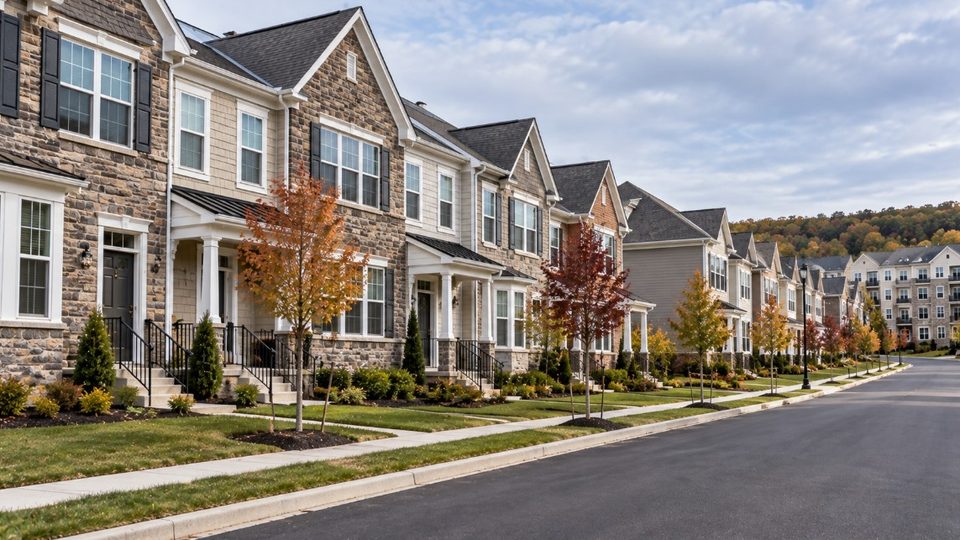
Valley Forge means two quite separate things when it comes to buildings. There is the historic area proper — the park landscape and the eighteenth and nineteenth century stone structures around it, in and adjacent to Valley Forge National Historical Park where the Continental Army encamped through the winter of 1777–78. And there is the modern Valley Forge address: the corporate and residential development along the Route 422 and North Gulph Road corridor, including the substantial apartment, townhome and condominium construction of the last fifteen years.
The two could not fail more differently. One has permanently damp masonry and no vapour barrier anywhere; the other is sealed so tightly that household moisture cannot get out. Both produce mold, by opposite mechanisms.
Valley Creek and the Schuylkill Confluence
Valley Creek runs down through the park and joins the Schuylkill at the northern edge. The creek corridor and the low ground along it are the local flood exposure, and that exposure is genuine: the September 2021 Ida event produced record flooding across southeastern Pennsylvania, and the Schuylkill floodplain around the confluence is not immune. Properties on the low ground near the creek or near the river should be assessed with that history in mind, and anyone buying here should check the FEMA flood map rather than relying on impressions of elevation.
The broader hydrology matters for the historic buildings as much as the flooding does. This is a valley floor with a high seasonal water table in places, on Piedmont geology, in a landscape shaped by the creek. Stone buildings sitting on that ground have been drawing groundwater up through their footings for two hundred years, and they always will.
The Historic Stone Buildings
The eighteenth and nineteenth century stone houses in and around the Valley Forge area were built of local fieldstone and schist, laid in lime mortar on rubble stone footings. There is no damp-proof course and there never was one — the concept did not enter building practice until long after these walls were built. The foundation is in permanent capillary contact with the ground, and water is continuously drawn upward through the masonry.
This is not a defect. It is how the buildings work, and they have remained sound for centuries doing it, because the entire assembly was vapour-open. Lime mortar, lime plaster, and unpainted or limewashed surfaces allowed water entering the wall to evaporate freely from the inside face. The wall was a moderating membrane rather than a barrier.
In nearly every case, a well-intentioned modern improvement:
- Repointing with Portland cement mortar. The cement joint is harder and far less permeable than the stone. Moisture that used to evaporate through the soft lime joint is forced out through the face of the stone instead, which spalls and eventually destroys it.
- Cementitious or elastomeric waterproof coatings on the interior face. These do not stop water entering. They stop it leaving, and it exits by blowing the coating off or spalling the masonry behind it.
- Framing an insulated stud wall against the stone. Creates a sealed, cold, permanently damp cavity with fiberglass and paper-faced drywall inside it. This produces some of the worst concealed mold found in historic properties in this region.
- Modern impermeable paint over lime plaster. Same principle at a smaller scale — trapped moisture blisters the paint and degrades the plaster beneath.
The correct approach for these buildings is management rather than defeat: lime-based mortars and plasters for repair, vapour-open finishes throughout, no sealed cavities against the stone, rigorous exterior water management — gutters, downspouts well away from the wall, grading falling off — and mechanical dehumidification to control the interior environment. Repair specification for historic masonry covers this in more detail.
The Modern Valley Forge Address
The apartment, townhome and condominium construction along the Route 422 and North Gulph Road corridor — including the Village at Valley Forge and the corporate-corridor residential development — has the opposite problem, and it is worth stating plainly that these are well-built buildings. The foundations are properly waterproofed, there are capillary breaks, and the flashing is detailed correctly. Nothing is leaking.
What they are is very tight. Modern energy codes produce envelopes with very low air leakage, which is excellent for heating and cooling costs. The consequence is that water vapour generated inside — cooking, showering, laundry, drying clothes indoors, houseplants, and simply breathing — has no path out unless one is deliberately provided.
Where a balanced ventilation unit was not installed, or was installed and subsequently switched off because it made noise or the occupant did not know what it was, indoor humidity climbs. Growth then appears in the predictable locations: north-facing exterior corners, behind furniture placed against outside walls, inside closets on exterior walls, around window reveals, and in and around the air handler closet. A humidity complaint in a four-year-old apartment here is a ventilation deficit, not a building failure.
Stacked multi-family construction adds a second issue: a leak in an upper unit becomes a mold problem in the unit below, and responsibility is then divided between owners and an association under the governing documents. Documentation from the first day matters enormously in those cases.
What to Check, by Building Type
| If you are in… | Check first |
|---|---|
| A pre-1900 stone house | Base of cellar walls for efflorescence and staining; any furred-out or studded basement finish; joist ends where they bear into the masonry; whether anything has been repointed in cement |
| A 19th-century addition or outbuilding conversion | The junction between old and new construction — differential movement and mismatched materials open moisture paths |
| A postwar single-family home nearby | Rim joist, kneewall attic if it is a Cape, and where the bath fan terminates |
| A 1980s–90s house with a finished basement | Bottom plate and lower drywall on every exterior basement wall |
| A new apartment, condo or townhome | Indoor relative humidity reading; whether the ERV or HRV is running; north-facing corners and exterior-wall closets |
| Anything on low ground near Valley Creek or the river | Flood history, the FEMA map, and the condition of the sump and its backup |
Local Assessment
Because the building stock here is so polarised, the diagnostic approach differs sharply between the two. Historic masonry needs surface temperature and dew point work, careful reading of efflorescence and salt patterns, and someone who understands why a lime wall must be allowed to breathe. Modern tight construction needs humidity monitoring, ventilation verification, and often nothing more. Sending the wrong approach to either produces the wrong answer.
Call and describe the building. A specialist will tell you which of these two you are dealing with and what it actually warrants — often considerably less than owners expect.
What We Get Called About Most in Valley Forge
Ranked by how often it comes up, and tied to the buildings that are actually here rather than to mold in general.
- Historic stone sealed with modern materialsRepointing in Portland cement, cementitious coatings on cellar walls, or a stud wall framed against the stone. All three trap moisture in masonry that stayed sound for two centuries by being able to dry inward.
- New apartments and townhomes that feel dampThe Village at Valley Forge and the corridor development are tight, well-built envelopes. Without a working ERV or HRV, household moisture has nowhere to go and condenses at north-facing corners and inside exterior-wall closets.
- Low ground near Valley Creek and the Schuylkill confluenceA steep, narrow valley collects runoff quickly. Flood exposure along the creek corridor is real and separate from the slower, larger Schuylkill events downstream.
- Junctions between original fabric and later additionsDifferential settlement, imperfect flashing and materials with different vapour behaviour meeting in ways nobody designed. Check these before anything else on an extended property.
Neighborhoods and Sections We Cover in Valley Forge
Mold Services Available in Valley Forge
Mold Inspection
Thermal imaging and moisture metering to locate the source before anything is opened up.
DetailsBasement Mold Removal
The dominant mold problem in Valley Forge — finished walls, stone foundations and sump failures.
DetailsBlack Mold Removal
Full containment for water-damage indicator species, plus finding the sustained water source.
DetailsAttic Mold Removal
Sheathing and rafter growth traced back to ventilation, bath fans or ice damming.
DetailsWater Damage & Flood Mold
Burst pipes, sump failures and flooding — the 24 to 48 hour response window.
DetailsClearance Testing
Independent verification by a hygienist who did not perform the remediation.
DetailsWhat Mold Work Costs in Valley Forge
General market ranges for the Greater Philadelphia area, listed for the situations that actually come up in Valley Forge. These are planning figures rather than quotes — nobody can price a job they have not seen, and what moves a number most is the size of the wet area rather than the stained area. The full cost guide explains what drives each one up or down.
| Work | Typical range | Notes |
|---|---|---|
| Mold inspection with thermal imaging and moisture metering | $300–$700 | Most projects should start here |
| Small contained area — one wall section, a closet, behind a water heater | $600–$1,800 | Under roughly 10–30 sq ft |
| Historic stone cellar, lime-based repair | $4,000–$12,000 | Specialised materials; often less demolition |
| Finished basement — wall removal, drying, clearance | $5,000–$15,000 | Excluding reconstruction |
| Lead and asbestos testing before demolition (pre-1978 building) | $400–$1,200 | Far cheaper in advance than discovered mid-job |
| Independent post-remediation clearance testing | $350–$700 | The only stage that produces evidence rather than assurance |
| Reconstruction after remediation | $25–$60 / sq ft | Quote this separately so you can compare bids |
Mold FAQ — Valley Forge, PA
For a pre-1900 stone building in this area, largely yes — and that is genuinely the honest answer rather than a dismissal. These foundations have no damp-proof course and are in permanent capillary contact with the ground. A cellar that is cool and slightly damp, with some efflorescence on the stone, is behaving as it was built to behave. What is not normal and does need attention: standing water, active mold growth, a strong musty odour reaching the living space, soft or crumbling mortar, or damp extending well up the wall. The management strategy for these buildings is exterior water control plus mechanical dehumidification, not sealing. Sealing is what breaks them.
You can, but not with a conventional assembly, and this is important enough to be blunt about. Framing a stud wall with fiberglass batts and paper-faced drywall against a stone foundation that is permanently drawing groundwater is close to a worst case — you create a cold, dark, sealed, damp cavity with cellulose in it. If you want to use the space, the approach is vapour-open throughout: no impermeable coatings, no sealed cavities against the stone, materials that tolerate moisture, a genuine air gap where anything is placed near the wall, and permanent dehumidification. Talk it through before committing to a design, because this is one of the situations where the standard contractor answer is the wrong one.
Parts of it, yes. Valley Creek runs through the park and joins the Schuylkill at the northern edge, and the low ground along the creek corridor and the river floodplain has real exposure. The September 2021 Ida event produced record flooding across southeastern Pennsylvania and demonstrated how quickly that can develop. Much of the higher ground — including a good deal of the modern corridor development — is not in a flood zone. The reliable way to know is to check the property against the FEMA flood map rather than judging by eye, and to ask a seller directly whether the property took water in 2021.
Very unlikely. That combination is the classic signature of an under-ventilated tight envelope, which is the standard profile in newer construction here. The building is doing exactly what it was designed to do — keeping air in — and the water vapour your household produces has nowhere to go. Check whether the unit has an ERV or HRV and whether it is switched on; run the bathroom fan for a full twenty minutes after showering; avoid drying laundry indoors; and put a hygrometer in the living space. If it reads above 55 percent you have confirmed it. Raise it with the management company as a ventilation question rather than a mold complaint — you will get a more useful response.
General market ranges: inspection roughly $300 to $700; a small contained remediation roughly $600 to $1,800; a finished basement roughly $4,000 to $12,000 excluding rebuild. Historic stone properties often run higher, not because the mold is worse but because the work requires appropriate materials and someone who knows how to use them — lime mortar repair, vapour-open finishes, and careful handling of original fabric. Pre-1978 buildings may also require lead and asbestos testing before demolition, which adds cost but is far cheaper identified in advance than discovered midway. Planning ranges, not quotes.