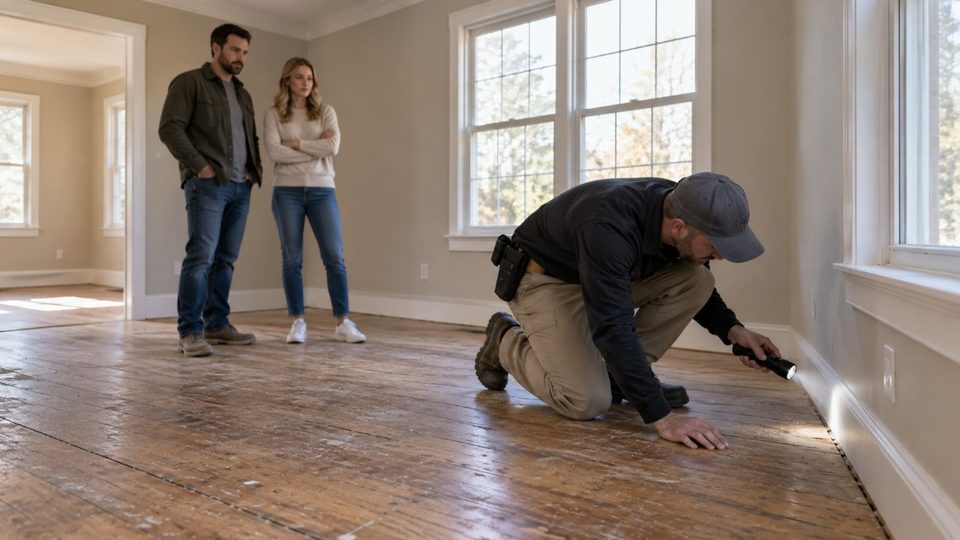
A Standard Home Inspection Is Not a Mold Inspection
This surprises most buyers, and it costs people a great deal of money in this market. A general home inspection in Pennsylvania is a broad visual survey of the whole property, performed in two to three hours. It is genuinely valuable and it is not designed to find concealed moisture.
A general inspector will note visible staining and visible growth, and a good one will flag conditions that suggest a problem. What they typically will not do is systematic moisture metering of wall cavities, thermal imaging of the whole envelope, dew point analysis against surface temperatures, or borescope inspection behind a finished basement wall. Many offer thermal imaging as a paid add-on; fewer carry out the confirming moisture readings that make a thermal image mean anything.
The dominant mold problem in this region is concealed: growth on the back of a finished basement wall, inside a kneewall attic cavity, or on attic sheathing above a bathroom. A staged house with a freshly painted basement can present perfectly at a showing while carrying a five-figure problem behind the drywall. The visible-only inspection is least effective against exactly the failure mode that is most common here.
Pennsylvania Seller Disclosure — What You Are Actually Owed
Pennsylvania has a real seller disclosure statute, and it is worth understanding precisely because buyers frequently over- or under-rely on it.
The Real Estate Seller Disclosure Law requires a seller of residential property to complete a disclosure statement covering known material defects, and the standard form includes items on water infiltration in the basement or crawl space, roof leaks, plumbing problems, and known mold or hazardous substances.
The critical limitation: the obligation is to disclose what the seller actually knows. It is not a warranty of condition and it does not create a duty to investigate. A seller who genuinely does not know about mold behind a basement wall has not violated the statute by failing to disclose it. And there are exemptions — estate sales, certain transfers, sheriff sales and some new construction may fall outside the requirement, which is exactly the category of transaction where undisclosed problems cluster.
So the disclosure statement is useful evidence and a poor substitute for inspection. Read it carefully, note what is disclosed and what is conspicuously answered “unknown”, and then inspect anyway. None of this is legal advice; if a disclosure issue arises in your transaction, speak to a Pennsylvania real estate attorney.
When a Dedicated Mold Inspection Is Worth It
Not on every purchase. It earns its cost when one or more of these apply:
- The basement is finished. The single strongest indicator in this region. You cannot see the assembly that most commonly fails.
- The property is in a flood-exposed area. Parts of Norristown, Bridgeport, Conshohocken, Collegeville and Royersford. Ask directly whether the property flooded during Ida in September 2021, and check the FEMA flood map.
- It is a pre-1950 home, particularly stone. Capillary rise, no damp-proof course, and often a century of ad hoc repairs.
- It is a 1940s or 1950s Cape. The kneewall attic cavities are rarely opened during a general inspection.
- There is any musty odour at all. Including one masked by air fresheners or a freshly painted basement, both of which should raise rather than lower your concern.
- The general inspection flagged moisture. Any mention of dampness, staining, efflorescence or elevated readings warrants a follow-up with instruments.
- The house has been vacant, or is a flip. Vacant properties have unrun dehumidifiers, unheated winters and sometimes failed sumps. Flips have fresh paint over unknown history.
- Anyone in your household has asthma or is immunocompromised. The threshold for wanting certainty is lower.
- It is an estate sale or a sale by a seller exempt from disclosure. Nobody may know the history, including the seller.
What to Have the Inspector Cover
- Finished basement wallsMoisture metering along the bottom plate and up the wall, thermal scan of the full area, and a borescope port where readings are elevated. Agree access for this with the seller in advance — it is a pencil-diameter hole, but it is still a hole in someone else's house.
- The rim joistPull back a section of insulation and look. Rarely done in a general inspection and frequently informative.
- Attic, including kneewall cavitiesSheathing condition on all planes, especially north-facing. Where every bath fan and dryer duct actually terminates — physically traced, not assumed.
- Crawl spaces, entered not glanced intoJoist and subfloor condition, vapour barrier, standing water, insulation condition, and probing for wood decay as distinct from surface growth.
- Every plumbing fixture baseUnder sinks, behind toilets at the flange, the washing machine box, the dishwasher bay, the water heater and its pan.
- The HVAC systemEvaporator coil examined directly with the cabinet open, drain pan and line condition, and where the air handler is located. An attic air handler with a blocked drain is a ceiling waiting to fall.
- Exterior water managementGrading in the first ten feet, downspout discharge points, window wells, and where the sump discharges. Cheap to observe and highly predictive.
- Air sampling if warrantedWith an outdoor control. Useful where there is odour without a visible source, or where you want a documented baseline at the point of purchase.
Using the Findings in the Transaction
A mold finding is usually a negotiation rather than a deal-breaker. What matters is converting a vague concern into a specific, costed item.
Get a remediation estimate, not just an inspection report. “There is mold in the basement” is a conversation. “Here is a written scope and a $9,400 estimate from a licensed and insured contractor” is a number, and numbers move.
Prefer a credit over seller-arranged work where you can. A seller motivated to close cheaply will commission the lowest bid, which in this trade frequently means a chemical treatment with no clearance testing. A credit lets you engage a contractor who answers to you and insist on independent verification.
If the seller does arrange the work, specify the conditions. Written scope naming the moisture source, independent clearance testing by a third party, the clearance report delivered to you before closing, and a walkthrough after completion.
Keep everything. The inspection report, the estimates, the scope, and the clearance report. When you come to sell, this file is what turns a difficult disclosure conversation into a straightforward one.
For Sellers
The same logic runs in reverse and it is worth acting on early. Discovering mold three days before closing, with a buyer's inspector's report in hand and no time to get competitive quotes, is the worst possible position. A pre-listing inspection gives you time to obtain multiple estimates, to have the work done properly with independent clearance, and to hand a buyer a completed file rather than a problem. In the Main Line and Montgomery County market, a documented, cleared remediation is a considerably smaller drag on a sale than an undocumented one — and under the disclosure law it is also much better to be disclosing.
Frequently Asked Questions
Only visually, and only what is accessible. A general home inspector will note visible growth and visible staining and will often flag conditions that suggest moisture, which is genuinely useful. What a standard inspection does not include is systematic moisture metering of wall cavities, thermal imaging of the whole envelope with confirming readings, dew point analysis, or borescope inspection behind finished surfaces. Since the dominant mold problem in this region is concealed behind finished basement walls and inside kneewall attics, the general inspection is weakest against the most common local failure. Many inspectors offer thermal imaging as an add-on — worth taking, but ask whether they confirm anomalies with a moisture meter, because a thermal image alone proves nothing.
General market ranges for this area: a dedicated mold inspection with thermal imaging and moisture metering, roughly $300 to $700. Adding air sampling with an outdoor control, roughly $250 to $500 more. A comprehensive package on a larger or older property, roughly $600 to $1,200. Against a purchase price in this market, and against remediation costs that routinely run into five figures for a failed basement, it is a proportionate expense on the properties listed above. It is not necessary on every purchase, and a good inspector will tell you so.
Take it seriously and verify it rather than accepting it. Ask three specific questions in writing: what exactly was done, who did it, and is there a clearance test or an invoice. A documented remediation with an independent clearance report is genuinely reassuring. “We had someone come and spray it” is not, and in this trade that phrase usually means a chemical treatment with no removal and no moisture correction. Then have it inspected with instruments regardless. Past water is the single best predictor of present concealed mold, and the fact that it was disclosed at all means the seller knows something happened — which is more than you get on most properties.
That depends on your agreement of sale and the contingencies in it. The standard Pennsylvania Association of Realtors agreement includes an inspection contingency that, where elected, generally allows a buyer to terminate or to negotiate based on inspection results within a defined period. The mechanics and deadlines matter a great deal and they are strict. Read your contingency language carefully, watch the dates, and speak to your agent and where necessary a Pennsylvania real estate attorney before the window closes. Nothing here is legal advice — but missing an inspection deadline is one of the most common and most expensive avoidable errors in a transaction.
If you have any reason to suspect an issue — a finished basement you have never opened, a past water event, a musty smell, an older home you have not inspected — then yes, and the reason is timing rather than disclosure. Finding a problem while you still have weeks gives you time to get three estimates, have the work done properly with independent clearance, and present a buyer with a completed file. Finding it three days before closing, through the buyer's inspector, means accepting whatever credit gets the deal closed. It also puts you in a better position under Pennsylvania's disclosure law, since a documented and cleared remediation is a much easier thing to disclose than an unresolved unknown.