Why Bathrooms Are Different From Every Other Room
A bathroom is the only room in a house that is deliberately filled with hot water vapour several times a day, and then expected to dry itself out. In a southeastern Pennsylvania house it frequently cannot, for reasons that have very little to do with cleaning.
A single shower releases roughly half a litre to a litre of water into the air. Two showers a day is somewhere between three and seven litres a week. That moisture has three possible destinations: out through the extractor fan, out through the window, or into the building fabric. In most homes here the third option takes a larger share than the owner realises — and the visible mold on the grout is the smallest part of the problem.
The Five Bathroom Mold Situations, From Cosmetic to Serious
- Surface growth on grout, caulk and sealantThe cosmetic tier. Usually Aureobasidium or Cladosporium on a persistently wet surface. Cleanable, genuinely a homeowner job, and it recurs until the surface stops staying wet. If silicone sealant has gone black through rather than on the surface, it needs cutting out and replacing rather than cleaning — the growth is inside the sealant.
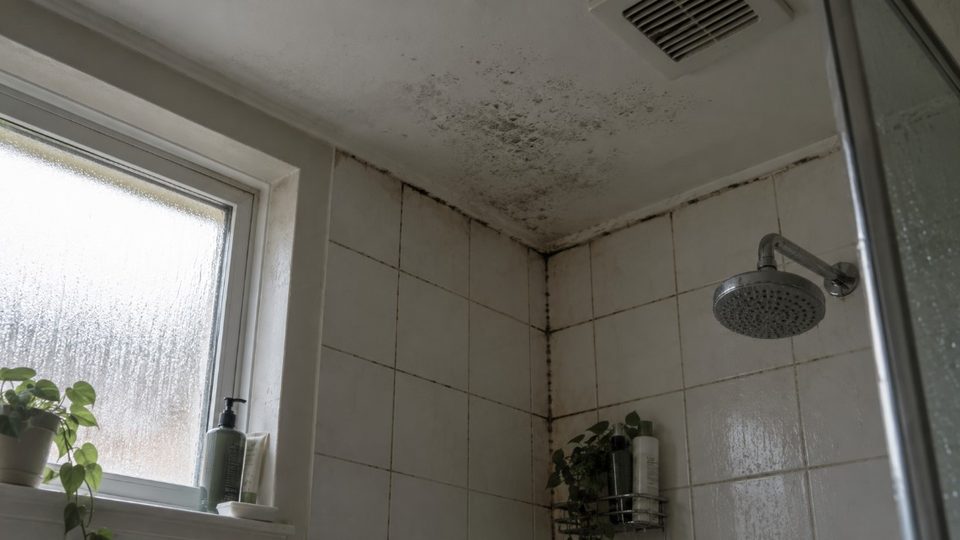
- Growth at the ceiling and the top of the wallsA ventilation failure. Warm moist air rises, reaches the coolest surface in the room, and condenses. Cleaning treats the symptom; the fix is a fan that is adequately sized, correctly ducted and actually running long enough.
- Behind the shower surround or tub enclosureA concealed tier. Fibreglass surrounds separate from the drywall over time and a hidden moisture channel opens between the surround and the framing. Nothing is visible in the bathroom while growth develops in the void. The signals are a surround that flexes when pressed, sealant that will not stay adhered, and a musty smell with no visible source.
- Under the floor, around the toilet and the shower baseA failed wax ring at the closet flange leaks a small amount at every flush, and it soaks the subfloor rather than showing on the surface. A shower pan failure does the same. Signals: a toilet that rocks slightly, discoloured or lifting flooring near the base, or a stain on the ceiling of the room below.
- In the ceiling below an upstairs bathroomThe serious tier, and it is a plumbing investigation rather than a bathroom one. By the time a stain appears on the ceiling below, the joist bay above has usually been wet for some time.
The Fan Is Almost Always the Answer
If there is one thing to take from this page: most bathroom mold in this region is an extraction problem wearing a cleaning problem's clothes. Four things go wrong, and all four are inexpensive to correct.
| Fault | Why it matters | Fix |
|---|---|---|
| Undersized fan | A rule of thumb is one CFM per square foot of floor area, 50 CFM minimum. Large rooms, enclosed showers and separate toilet compartments need more. | Replace, and match duct diameter to the fan outlet — reducing a 4″ outlet into a 3″ duct destroys the airflow |
| Runs only during the shower | The moisture that matters is evaporating off wet surfaces and towels after you leave. Twenty minutes of run-on is what is needed. | A timer switch, or a humidity-sensing fan. A few dollars, and the highest-value item here |
| Too loud, so nobody uses it | An unused fan is identical to no fan. This is the most common real-world failure of all. | Modern fans rated at or below 1.0 sone are quiet enough that people leave them running |
| Discharges into the attic | Delivers saturated shower air straight at cold roof sheathing every day. Very common in unmodernised housing here. | Reroute through the roof or a gable with insulated duct and a damper — never into a soffit. How to check yours |
What Makes Bathrooms Worse in This Region Specifically
Cold exterior walls in winter. A bathroom on an exterior wall, or with an exterior-wall shower, has a genuinely cold surface for eight months of the year. Warm shower air condenses on it, and where the insulation is poor or the framing forms a thermal bridge, the coldest line is often exactly where the growth appears.
Second-floor bathrooms over unheated space. A bathroom above a garage or a porch has a cold floor assembly, and the cold surface is underfoot.
Older housing with no fan at all. A great deal of the pre-1960 stock in Upper Merion, Norristown, Conshohocken and the boroughs was built with an openable window and nothing else. That worked when people opened windows; it does not work in February.
Original tile and grout past its life. Grout and sealant from the 1960s and 1970s have generally failed, and water entering behind a tiled wall feeds growth in the framing cavity with nothing visible on the tile face.
Tight new construction. In newer townhomes and condos the bathroom is the largest single moisture source in a building envelope that leaks very little. Without adequate extraction it does not merely affect the bathroom — it raises humidity throughout the home.
Cleaning It Properly — and Knowing When Not To
Surface growth on non-porous tile, glass and glazed porcelain is a genuine homeowner job. Detergent and water with a brush does most of the work; the mechanical removal matters more than the product. On non-porous surfaces a dilute bleach solution is acceptable, though it is not necessary and it does nothing that thorough scrubbing does not. Wear gloves and ventilate, and never mix bleach with any ammonia-containing cleaner.
Where to stop and call someone:
- Growth that returns within weeks of cleaning — the surface is still getting wet, and cleaning is not the answer
- A soft or spongy floor, or a toilet that rocks
- A shower surround that flexes, or sealant that will not stay adhered
- A stain on the ceiling of the room below
- A musty smell with nothing visible — the growth is behind something
- Any area larger than roughly ten square feet, or anything on drywall rather than tile
Mold-resistant bathroom paint resists colonisation of the paint film itself. It does nothing about growth already on the substrate beneath, and nothing about the moisture. Painting over a mouldy bathroom ceiling buys a few months and makes the eventual diagnosis harder, because the evidence of how far it extended is now under a coat of emulsion.
Frequently Asked Questions
Because cleaning removes the growth and changes nothing about the conditions. Mold does not return to a surface that stays dry — so recurrence is definitive proof that the surface is still getting wet and staying wet. In a bathroom that almost always means extraction: a fan that is undersized, that stops when you leave, that is too loud to use, or that discharges into the attic. Fix the ventilation and the cleaning holds. Keep cleaning without fixing it and you are on a permanent schedule.
General market ranges for this area: surface cleaning and resealing, frequently a homeowner job or $200 to $600 professionally. Removing and replacing a failed shower surround with remediation of the cavity behind, roughly $1,500 to $5,000. Subfloor repair after a long-running toilet or shower pan leak, roughly $1,500 to $6,000. A full bathroom rebuild after remediation, roughly $6,000 to $25,000. And the fix that prevents most of it — rerouting a bath fan properly and fitting a timer — roughly $400 to $1,200. Planning figures, not quotes.
In this climate, yes, for most of the year. A window works in mild weather when outdoor air is drier than indoor air. In January nobody opens a bathroom window for twenty minutes, and in a humid July the outdoor air you let in carries a dew point in the low 70s — which is not drying anything. A fan works regardless of season, it can run on a timer after you leave, and it exhausts the moisture outside the building rather than moving it to the landing.
If it is on the surface, yes — a bathroom cleaner and a brush will lift it. If the black is within the silicone, showing as dark specks under the surface rather than on it, no amount of cleaning reaches it because the growth is inside the sealant itself. That needs cutting out completely, the joint cleaned and dried thoroughly, and fresh sanitary-grade silicone applied. Doing it properly takes an hour or two; doing it over the top of the old sealant guarantees it returns within months.
Fitting one is almost always possible and it is the right answer. Ducting through a gable wall or through the roof is straightforward in most houses; on a ground-floor bathroom an exterior wall fan is simpler still. Where the ceiling genuinely cannot be accessed, a through-wall unit or an inline fan mounted remotely with ducting are both workable. Budget roughly $400 to $1,200 including electrical work and a proper exterior termination. In an older house with no fan, this is usually the single highest-value moisture improvement available.