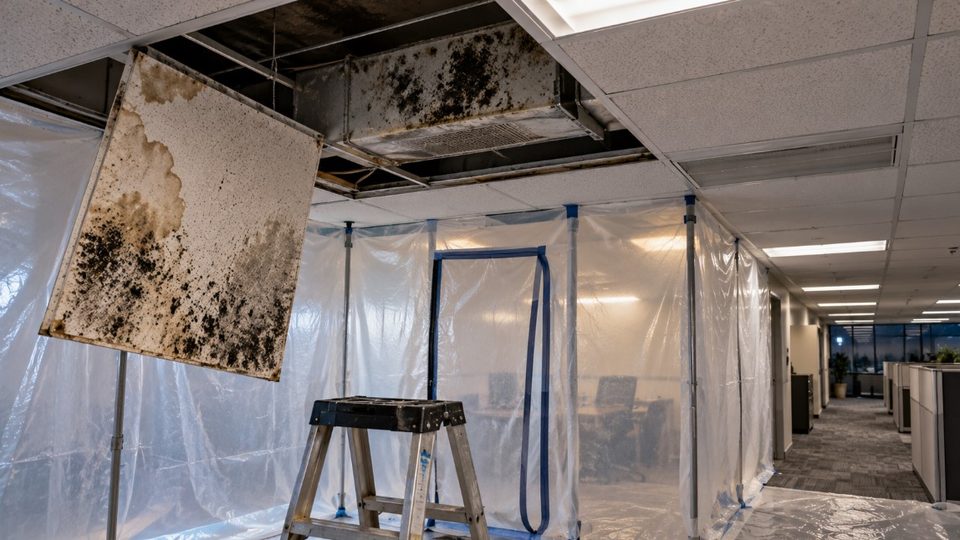
Commercial Mold Work Is a Different Problem
Technically, the remediation is the same: find the water, contain, remove, dry, verify. Everything around it is different. A commercial project has occupants who are not your family, a business that cannot simply stop, a landlord or a tenant on the other side of a lease, an insurer, and in many cases a regulatory or contractual obligation to notify people. The building science is the easy part.
The King of Prussia area is a genuinely dense commercial market — the office parks along the Route 202 and First Avenue corridors, the retail concentration around the mall and Town Center, the Renaissance and Freedom business parks, the Eagleview Corporate Center in Chester County, the converted mill buildings along the Schuylkill in Conshohocken and Norristown, and a large stock of multi-family rental property throughout Montgomery County. Each brings its own constraints.
Property Types and What Goes Wrong in Each
Office buildings and corporate parks
The dominant issue is the mechanical system. Large commercial HVAC plant moves enormous volumes of air, and a contamination source at an air handler, a cooling coil, a drain pan or in a section of duct is distributed building-wide within minutes. Complaints typically present as a cluster of occupants in one zone reporting headaches, congestion or a musty smell — which maps to an air handling unit rather than to a physical location.
Other recurring sources: flat and low-slope roofs, which are unforgiving of any drainage failure and frequently hide saturated insulation above the deck long before a ceiling tile stains; perimeter curtain wall and window sealant failures; and interstitial condensation in the plenum where cold supply ductwork runs through a warm return-air space.
Retail and restaurants
High moisture loads from dishwashing, ice machines, walk-in coolers and cooking, combined with fit-outs that have been changed repeatedly by successive tenants. Condensation on and around walk-in refrigeration is a reliable source. So are abandoned plumbing penetrations from a previous tenant’s layout. Restaurants also carry a health-inspection dimension: a mold finding can become an operational problem quickly, which is why after-hours and overnight scheduling matters.
Multi-family residential and apartment buildings
The most legally sensitive category in Pennsylvania. A water event in one unit affects units below and beside it, and the landlord carries obligations to every affected tenant. Unit-by-unit complaints are frequently the first indication of a building-wide envelope or ventilation problem rather than an isolated leak. Bathroom exhaust that is ducted into a shared shaft or, worse, into the ceiling void rather than outdoors, is endemic in older apartment stock.
Converted industrial and mill buildings
Conshohocken, Norristown and Bridgeport have substantial stock of converted mill and industrial buildings along the Schuylkill. These combine several difficult characteristics: massive masonry walls with no damp-proofing and permanent capillary contact with the ground; lower levels at or below the river’s flood elevation; and modern insulated fit-outs installed inside a historic envelope that was never designed to be sealed. When they flood — and along that stretch of river they do — the masonry holds water for a very long time after the visible water has gone.
Schools, childcare and healthcare
Heightened sensitivity, vulnerable occupants, and in healthcare settings, infection-control requirements that govern how construction and remediation work may be carried out in occupied areas. These projects require containment planning, negative-pressure verification and often phased scheduling around occupancy. They should only be undertaken by contractors with direct experience of the setting.
Landlord and Tenant Obligations in Pennsylvania
Pennsylvania has no mold-specific statute. What governs residential rental property is the implied warranty of habitability, established in Pennsylvania case law, which requires a landlord to maintain a rental unit in a condition fit for human habitation. Conditions involving significant water intrusion and mold growth have been treated as habitability issues. Remedies available to tenants have included repair-and-deduct and rent escrow, though the specific procedure matters and getting it wrong can expose a tenant to eviction.
Commercial leases are a different matter entirely: they are governed by the lease document, not by habitability doctrine. Whether the landlord or the tenant is responsible for a mold problem generally depends on where it originated, what the lease says about maintenance of the structure versus the premises, and what the lease says about business interruption.
- Landlords: respond in writing and promptly, document everything with dates, and get an independent inspection before any demolition. The largest liability exposures come from delay and from undocumented work, not from the mold itself.
- Tenants: give written notice, keep copies, photograph everything with dates, and do not withhold rent without first getting advice on the correct procedure. An improperly executed rent withholding is grounds for eviction.
- Both: nothing in this section is legal advice. Pennsylvania landlord-tenant procedure is specific, and where money or tenancy is at stake, speak to a Pennsylvania attorney. Montgomery County Legal Aid is a resource for tenants who cannot afford private counsel.
How Commercial Projects Are Scheduled and Run
- Assessment outside operating hoursMost commercial assessment is done evenings, overnight or at weekends so that occupants are not present and the HVAC can be run and stopped as needed for diagnosis.
- Occupant and stakeholder communication planAgreed before work starts: who is notified, when, and what they are told. Silence generates more complaints than the mold does.
- Phased containmentWork is sequenced so the business keeps operating — zone by zone, floor by floor, or unit by unit — with hard containment and verified negative pressure between the work area and occupied space.
- HVAC isolationAffected zones are isolated from the air distribution system before any demolition. On a shared system this is the single most important step in preventing a localised problem from becoming a building-wide one.
- Documented remediationDaily logs, moisture readings, photographic records — because on a commercial project this documentation will be read by an insurer, a landlord, a tenant, or all three.
- Independent clearance, zone by zoneThird-party verification before each zone is released back to occupancy, with a written clearance report per zone.
- Root-cause correctionRoof, envelope or mechanical correction scoped separately — often as a capital item on a different timeline and budget from the remediation.
Business Interruption and Documentation
On a commercial claim, the documentation is frequently worth more than the remediation itself. Business interruption coverage, where it exists, generally requires demonstrating the cause, the date of loss, the necessity of the closure or partial closure, and the duration. That means the sequence has to be right: document conditions, establish cause, produce a written scope, then remediate. Demolishing first and documenting afterwards has sunk a great many otherwise valid claims.
Keep: dated photographs of every affected area before anything is touched; the independent inspection report with moisture readings; laboratory results with outdoor controls; the written scope of work; daily drying logs; the clearance report; and a contemporaneous record of operational impact. Assemble it as you go, not at the end.
Frequently Asked Questions
In most cases, yes. Commercial remediation is routinely phased so that a business keeps operating — zone by zone or floor by floor, with hard containment and verified negative pressure separating the work area from occupied space, and the noisy or disruptive phases scheduled overnight or at weekends. Full closure becomes necessary when the affected area includes the only means of egress, when the HVAC system serving occupied space cannot be isolated from the work, or where a regulator or the building owner requires it. This should be established at the scoping stage, before you commit, so you can plan around it.
The lease decides, not general principle. Look for the clauses covering maintenance and repair of the structure versus the premises, the definition of the demised premises, any provision on latent defects, and the casualty and business interruption clauses. As a rough pattern: problems originating in the building structure, roof or base-building systems usually fall to the landlord, while problems originating within the tenant's fit-out or from tenant operations fall to the tenant. Where it actually originated is a technical question, and an independent inspection report establishing origin is usually what resolves the commercial dispute. Have a Pennsylvania attorney read the lease before accepting responsibility either way.
Respond in writing the same day, even if only to acknowledge and schedule. Document the unit's condition with dated photographs. Get an independent inspection rather than relying on a visual opinion, because if this escalates you will need evidence of what was actually there. Check the units above, below and adjacent, since a single complaint is often the first symptom of a building-level issue. Fix the moisture source, not just the visible growth. And keep a complete written record of the timeline. In Pennsylvania habitability disputes, landlords very rarely lose on the mold itself — they lose on documented delay and on failure to respond.
Commercial pricing varies far more than residential because scope, access and scheduling dominate. General planning ranges for this market: a single contained office area, roughly $3,000 to $12,000. A floor or zone of a commercial building, commonly $15,000 to $60,000. Commercial HVAC system remediation, highly variable but frequently $8,000 to $40,000 depending on system size and duct configuration. Overnight and weekend scheduling typically adds twenty to forty percent. Multi-unit residential is usually priced per unit plus common areas. These are planning figures only — a commercial scope genuinely requires a site visit.
Pennsylvania has no general statutory mold notification requirement, but that is not the end of the question. Residential landlords have habitability obligations and practical exposure if a tenant later demonstrates they were kept in the dark. Employers have general duty obligations regarding workplace conditions. Leases and association documents frequently contain their own notification requirements. And there is the practical reality that plastic sheeting and negative air machines in a corridor generate rumour far worse than a straightforward notice would. Our consistent advice is to communicate early, plainly and in writing: what was found, what is being done, what the timeline is, and who to contact with questions. For anything with legal exposure, have counsel review the wording.