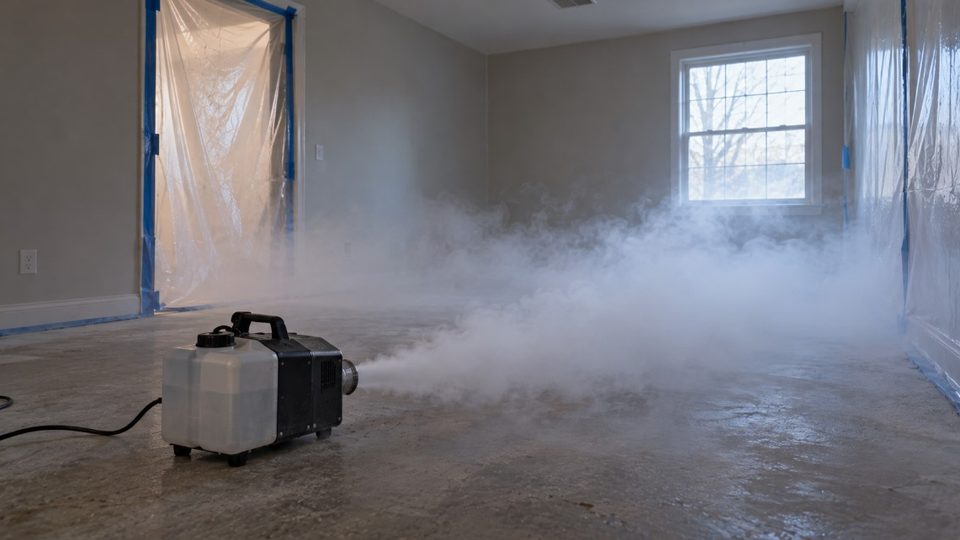
What Dry Fog Is, in Plain Terms
Dry fog remediation uses specialised equipment to atomise a treatment solution into extremely fine droplets — on the order of ten microns or less. At that size the droplets behave more like a gas than a spray: they remain suspended in air, circulate throughout a space, penetrate into gaps and cavities, and settle onto surfaces without visibly wetting them. Hence “dry” fog.
Two stages are normally used. The first is a sterilant fog, commonly a chlorine dioxide or hydrogen peroxide based chemistry, intended to inactivate fungal material it contacts. The second is an antimicrobial fog that leaves a residual film on surfaces. The whole process for a residential building typically takes several hours, and the space must be unoccupied during treatment and for a period afterwards.
The Honest Assessment
This is a service that attracts strong opinions in both directions, and we would rather give you a straight read than a sales pitch.
What it genuinely does well. It reaches places that hands and vacuums cannot: wall cavities, the backs of fixed cabinetry, the interiors of complex framing, contents stored in a treated space, and the surfaces of stored belongings. It treats an entire volume at once rather than surface by surface. It requires little or no demolition, which is a real advantage where demolition is impractical — occupied commercial space, a historic interior, or a whole-contents treatment after a smoke or mold event.
What it cannot do, and where the marketing overreaches. Fog does not remove anything. It may inactivate organisms it reaches, but dead spores and fungal fragments remain in place and remain allergenic — this is well established and is the central reason the IICRC S520 standard is built around removal rather than treatment. Fog does not penetrate into the depth of a saturated porous material; it treats surfaces, including the surfaces inside a cavity, but it does not sterilise the interior of a wet fibreglass batt or the core of a soaked sheet of drywall. And fog does nothing whatsoever about the water.
If a company proposes dry fogging instead of removing wet, contaminated drywall, insulation or carpet pad, decline it. That is not a remediation method; it is an odour and surface treatment being sold as one. The tell is usually the pitch: “no demolition, no mess, done in a day, whole house treated.” Where there is genuinely saturated porous material, a job that requires no demolition is a job that is not being done.
Where Dry Fog Is Actually the Right Tool
- As a supplementary step after removal and cleaning. The clearest legitimate use. The contaminated material is out, the surfaces are cleaned, and fogging then addresses residual material in cavities and on surfaces that could not be reached mechanically. This is a sensible sequence and it is where serious remediators use it.
- Contents treatment. Books, documents, textiles, stored belongings, electronics and furniture in a space that was contaminated. These cannot be wet-cleaned and are often uneconomic to replace. Fog treatment of contents is genuinely useful.
- Occupied commercial space where demolition is not viable. An office floor, a retail unit, a healthcare setting where taking walls apart would close the business. Often combined with targeted removal in the worst areas.
- Historic interiors. Where original plaster, panelling or millwork would be destroyed by removal, and where the contamination is surface-level rather than embedded in saturated material.
- Large volumes of complex framing. A crawl space or an attic with intricate framing where mechanical cleaning of every surface is impractical — as a supplement to blasting and vacuuming, not instead of it.
- Post-flood contents and cavity treatment. After the contaminated porous material has been removed and the structure dried, as an additional measure.
Where It Is the Wrong Tool
| Situation | Why fogging is not the answer |
|---|---|
| Wet, colonised drywall in place | The material must be removed. Treating it leaves saturated, contaminated cellulose inside the wall. |
| Wet fibreglass insulation | Cannot be cleaned or dried in place reliably. It comes out. |
| Active water intrusion | Nothing works until the water stops. Fog does not address moisture at all. |
| Carpet pad after a Category 2 or 3 loss | Open-cell material that has absorbed contaminated water. Removal, not treatment. |
| Sewage contamination | Category 3 requires physical removal of all contacted porous material. Fogging is not a substitute. |
| Structural wood decay | A structural problem, not a surface one. Requires repair or replacement. |
| As a cheaper alternative to a proper scope | If it is being offered because it avoids the cost of doing the job properly, that is exactly the reason to refuse. |
What Dry Fog Costs in the Greater Philadelphia Market
Fogging is usually quoted one of three ways, and the figures below are planning ranges for this market rather than quotes.
- Whole-house treatment — roughly $1,500 to $5,000, depending on square footage and how much of the building is included.
- A single level or a defined area — roughly $800 to $2,500.
- Contents only — commonly $500 to $2,000, priced by volume or by room.
- Commercial space is priced per square foot and varies too widely to range usefully.
The number that should make you stop is a whole-house fog quoted well below a conventional remediation. It is cheaper because it omits the removal and reconstruction the job actually needs, so the comparison is not like for like. If fogging is being offered instead of removing wet material rather than in addition to it, you are not comparing two prices for the same work. The full cost guide sets out what conventional remediation runs to here.
Practical Considerations
Occupancy. The building must be vacated during treatment and for a re-entry period specified by the product label, typically several hours. Pets, plants and fish must be removed. This is not a service that can be performed around people.
Preparation. Food and medications are removed or sealed. HVAC handling is planned — sometimes the system is run deliberately to distribute the fog through the ductwork, sometimes it is isolated. Sensitive electronics and artwork may need protection depending on the chemistry used.
Chemistry and disclosure. Ask which product is being used and ask for the safety data sheet. Chlorine dioxide is a strong oxidiser and can affect some materials and finishes. Hydrogen peroxide based systems are generally gentler. Anyone who will not tell you what they are fogging into your house should not be fogging anything into your house.
Verification. As with any remediation, the result should be verified independently. Fogging does not exempt a project from clearance testing, and a contractor who suggests it does is telling you something about their standards.
Frequently Asked Questions
As a supplementary step, yes — it is a genuinely useful tool for treating surfaces and cavities that cannot be reached mechanically, and for contents that cannot be wet-cleaned. As a standalone replacement for removing wet contaminated material, no. The industry standard of care, IICRC S520, is built around physical removal precisely because dead spores and fungal fragments remain allergenic; killing an organism is not the same as removing it. The useful question to ask a contractor proposing fogging is simply: “what porous material are you removing, and what is the fogging doing that the removal cannot?” A good answer exists. If there is not one, the fogging is doing the job of a chequebook rather than a method.
Whole-house treatment runs roughly $1,500 to $5,000 in this market, a single level or defined area $800 to $2,500, and contents-only treatment $500 to $2,000. The ranges and the one quote pattern worth refusing are set out in the cost section above.
The building has to be unoccupied during treatment and for a re-entry period afterwards, which is typically a few hours and is specified on the product label. Pets, fish and plants must be removed. The chemistries commonly used — chlorine dioxide and hydrogen peroxide based systems — are registered products used within label conditions, and once the re-entry period has elapsed and the space is ventilated, residual exposure is low. Ask for the safety data sheet before the work, and follow the re-entry timing exactly rather than approximately. If anyone in the household has significant respiratory disease, mention it when booking so the re-entry period can be extended.
Usually it will reduce or eliminate it, at least for a while — and that is precisely why it needs to be thought about carefully. A musty smell is microbial VOCs produced by active growth. Fogging inactivates organisms on the surfaces it reaches, so the odour production drops and the space smells clean. If the moisture source is still active and there is still saturated material in a cavity, growth resumes and the odour returns, typically within months. Removing the odour without removing the cause is a genuine risk with this method, because it takes away the one symptom that was telling you something was wrong.
It depends entirely on whether there is saturated porous material in the building, and that is a question of fact rather than opinion. If the contamination is genuinely surface-level — growth on non-porous or semi-porous surfaces, nothing soaked — then a no-demolition approach can be reasonable. If there is wet drywall, wet insulation or wet carpet pad, no amount of fog changes the fact that those materials have to come out. Ask for moisture readings. If material is reading well above target and the proposal still involves no removal, you are being offered a treatment rather than a remediation, and you should get a second opinion before agreeing.