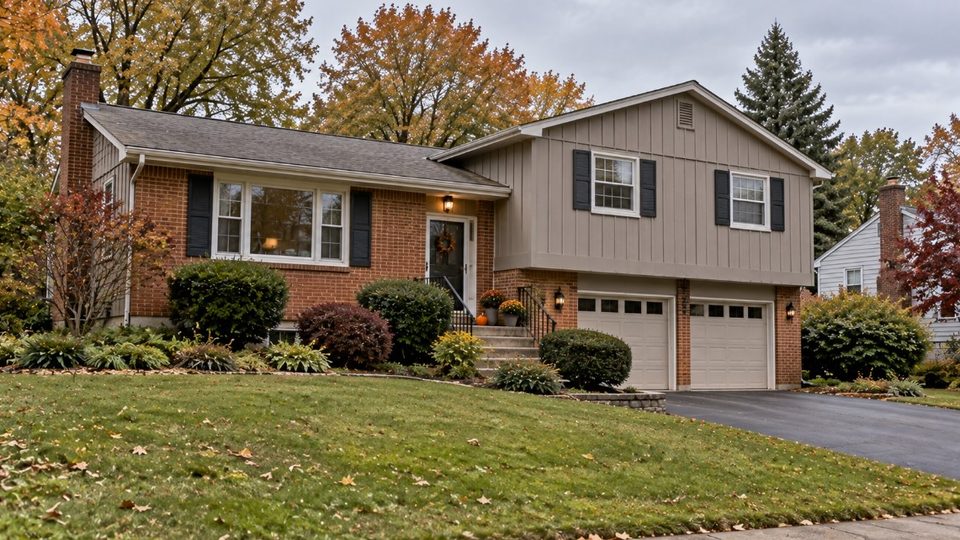
Upper Merion Residential, and What That Means for Moisture
Maplewood is a residential section of Upper Merion Township within the King of Prussia 19406 area. Like most of the township’s established neighbourhoods, its housing belongs principally to the great postwar expansion — Upper Merion gained roughly 650 new residents a year between 1950 and 1980, and the Capes, ranches, split-levels and colonials built to house them still make up a very large share of the single-family stock here.
That matters more than any local history, because in mold work the construction era is the diagnosis. A house built in 1954 has a specific and predictable set of weaknesses, and they are the same in Maplewood as they are three miles away.
What Mid-Century Upper Merion Housing Does Wrong
The kneewall attic, in any Cape or Cape-style house
If the upstairs rooms have sloped ceilings meeting a short vertical wall, there is a triangular void behind that wall running the length of the house on both sides. It sits outside the insulated envelope but is connected to the heated house by every framing gap, every wire penetration, and an access hatch that is usually neither insulated nor weatherstripped.
All winter, warm humid indoor air leaks into that void and meets roof sheathing that may be at 20°F. It condenses, and in very cold weather it forms frost that later melts and soaks the wood. Growth appears on the back of the kneewall, on the sheathing and on the joists of the void — in a space most homeowners enter once a decade.
Bath fans that do not go outside
Endemic in unmodernised postwar housing. A fan that discharges into the attic, or through a flexible duct that has fallen off its termination, or that was never connected at all, delivers saturated shower air directly at cold sheathing every single day. The signature is a distinct dark cone or halo on the sheathing directly above the bathroom. It is one of the most common causes we see and one of the cheapest to correct.
The rim joist
The band of framing that sits on top of the foundation wall. In pre-1980 construction it is typically bare; in later work it holds a fiberglass batt with nothing air-sealing it. It is the coldest wood in the building in winter and a prime condensation surface in summer. Almost nobody looks at it. Pull back a batt in your own basement and you will know more about your house in thirty seconds than most inspections will tell you.
Below-grade living space in split-levels
The split-level puts a partially buried lower level into full residential use — the moisture exposure of a basement with the finishes of a living room. Carpet, drywall and baseboard installed directly against a partly buried wall are precisely the wrong materials for that location when the wall takes on water, whether by seepage or by condensation.
Basements finished later
Where a basement in one of these houses was finished in the 1980s or 1990s — which many were — the assembly is almost certainly a stud wall built against the foundation, fiberglass batts between the studs, and paper-faced drywall over it. This is the most reliable concealed mold generator in the county. Growth begins on the back of the board and runs for years before it produces an odour in the room.
Original single-pane and early double-pane windows
Heavy winter condensation on the glass runs down and soaks the sill and the wall below. Rotted sills and staining beneath windows on the north side of the house are a common finding in this housing and are frequently attributed to a leak that does not exist.
The Two-Season Pattern, Which Explains Most of It
Summer. The buried foundation wall sits at roughly 52 to 58°F all year. From June through September, outdoor dew points across this region run in the mid-60s to low 70s°F. Air at those dew points reaching a 55°F wall is already saturated at that surface and gives up liquid water onto the masonry, onto cold copper supply lines, and onto the underside of the floor above. No leak is involved. If your basement is damp in July and dry in January, this is what you have.
Winter. The vapour drive reverses and the cold surfaces move into the assemblies — the back of exterior sheathing, the underside of roof decking, the kneewall cavity. Add the region’s freeze-thaw cycling and roughly 17 inches of average annual snowfall and you get ice damming at the eaves, which pushes water back under the shingles and into the top plate and wall cavity below. Because that happens in February and often does not stain until the following summer, it is regularly diagnosed as a summer roof leak.
Opening the basement windows on a humid July day to dry it out. In this climate that imports 70°F dew-point air onto 55°F masonry and deposits more water than the ventilation removes. Close the basement to outdoor air through the humid months and run a correctly sized dehumidifier, plumbed to the sump or a floor drain, set to 45–50%. This single change resolves a large share of basement mold complaints in Upper Merion.
A Sensible Order of Work
- Measure before you spendA hygrometer in the basement and one on the main floor, read over a few weeks in different weather. You will learn more than a paid opinion will tell you.
- Manage the water outsideGutters clear, downspouts discharging six feet or more from the wall, grading falling away for the first ten feet. Free or cheap, and it resolves a surprising proportion of basement dampness.
- Verify every exhaust terminationBath fans, kitchen hood, dryer. Go into the attic and physically follow the ducts. This is the most commonly wrong thing in this housing stock.
- Dehumidify properlyCorrectly sized, plumbed to a drain, running April through October at 45–50%.
- Address the cold surfacesAir-seal and insulate the rim joist, insulate cold water lines, and air-seal the kneewall hatch and penetrations.
- Then investigate what remainsIf there is still odour or visible growth after the above, that is the point at which an instrumented inspection earns its cost.
What We Get Called About Most in Maplewood
Ranked by how often it comes up, and tied to the buildings that are actually here rather than to mold in general.
- Kneewall attics in postwar CapesThe defining vulnerability of the housing built during Upper Merion's 1950–1980 expansion. Warm indoor air leaks into an unconditioned triangle all winter and condenses on cold sheathing.
- Bath fans that terminate in the atticSeveral litres of shower water a week delivered straight at cold roof decking. Free to check, and among the cheapest real fixes available in this housing stock.
- Below-grade living space in split-levelsCarpet, drywall and baseboard installed directly against a partly buried wall — the moisture exposure of a basement with the finishes of a living room.
- Original windows condensing in winterHeavy condensation on single-pane and early double-pane glass runs down and soaks the sill and the wall beneath. Frequently blamed on a leak that does not exist.
Neighborhoods and Sections We Cover in Maplewood
Mold Services Available in Maplewood
Mold Inspection
Thermal imaging and moisture metering to locate the source before anything is opened up.
DetailsBasement Mold Removal
The dominant mold problem in Maplewood — finished walls, stone foundations and sump failures.
DetailsBlack Mold Removal
Full containment for water-damage indicator species, plus finding the sustained water source.
DetailsAttic Mold Removal
Sheathing and rafter growth traced back to ventilation, bath fans or ice damming.
DetailsWater Damage & Flood Mold
Burst pipes, sump failures and flooding — the 24 to 48 hour response window.
DetailsClearance Testing
Independent verification by a hygienist who did not perform the remediation.
DetailsWhat Mold Work Costs in Maplewood
General market ranges for the Greater Philadelphia area, listed for the situations that actually come up in Maplewood. These are planning figures rather than quotes — nobody can price a job they have not seen, and what moves a number most is the size of the wet area rather than the stained area. The full cost guide explains what drives each one up or down.
| Work | Typical range | Notes |
|---|---|---|
| Mold inspection with thermal imaging and moisture metering | $300–$700 | Most projects should start here |
| Small contained area — one wall section, a closet, behind a water heater | $600–$1,800 | Under roughly 10–30 sq ft |
| Single room | $1,500–$4,500 | Containment, removal, drying, clearance |
| Finished basement — wall removal, drying, clearance | $5,000–$15,000 | Excluding reconstruction |
| Attic remediation with cleaning, treatment and re-insulation | $3,500–$9,000 | Plus $400–$1,200 to reroute a bath fan properly |
| Bath fan rerouted to a proper exterior termination | $400–$1,200 | Per fan — often the single cheapest real fix |
| Independent post-remediation clearance testing | $350–$700 | The only stage that produces evidence rather than assurance |
Mold FAQ — Maplewood, PA
Maplewood is a residential section of Upper Merion Township within the King of Prussia 19406 area, Montgomery County. It is not a separate municipality — municipal services, schools and ZIP code are all Upper Merion and King of Prussia. From a mold standpoint that means everything on our King of Prussia page applies directly, and the dominant factor is the township's postwar and mid-century building stock rather than anything specific to the section itself.
Probably not. In postwar housing of this type the water almost always comes from inside the house rather than from outside it. The two most common causes are a bathroom exhaust fan discharging into the attic instead of through the roof, and warm humid indoor air leaking up through gaps in the ceiling — recessed lights, the attic hatch, plumbing stacks, wiring holes — and condensing on cold sheathing. Read the pattern: a distinct dark cone above a bathroom means the fan; general staining worst near the ridge or on the north plane means air leakage or blocked soffit venting; staining concentrated at the eaves means ice damming. A genuine roof leak produces a localised stain traceable to a specific penetration and is the least common of the five causes.
Yes, if you build it correctly — and the difference in cost is modest while the difference in outcome is enormous. The conventional assembly that failed in thousands of local homes is stud wall against the foundation, fiberglass batts, paper-faced drywall, carpet on the slab. The assembly that works here is rigid foam board adhered directly to the masonry with taped seams, framing held clear in front of it, mineral wool rather than fiberglass if extra insulation is wanted, paperless or fibreglass-faced gypsum board, and a floating floor over a dimpled membrane instead of carpet pad on concrete. Plus permanent dehumidification. That specification costs roughly fifteen to twenty percent more and is the difference between a basement that lasts and one you tear out in a decade.
General market ranges for this area: a dedicated mold inspection with thermal imaging and moisture metering, roughly $300 to $700 for a typical single-family home. Adding air sampling with an outdoor control, roughly $250 to $500 more. A comprehensive package on a larger or older property, roughly $600 to $1,200. Before paying for anything, call the line — describing the seasonal pattern and the age of the house is often enough for a specialist to tell you whether an inspection is warranted at all. That conversation is free.
For active water intrusion — a failed sump, a burst pipe, flooding — someone is available around the clock and same-day attendance is normal in Upper Merion. For non-urgent inspections, typically within a few business days. Late summer and the period following any significant storm are the busiest times of year in this region, so if you are planning a non-urgent inspection, the quieter months are easier to schedule.