What an Ice Dam Actually Is
Most people picture an ice dam as a weather event. It is not. It is a heat loss event that happens to involve snow, and understanding that is the difference between fixing it and paying for a gutter heater that does nothing.
The sequence:
- Heat escapes into the atticThrough recessed lights, the attic hatch, plumbing stacks, wiring penetrations, the tops of interior walls, and inadequate insulation. It warms the underside of the roof deck.
- Snow on the upper roof melts from belowNot from sunshine — from the heat coming up through the roof. This can happen at outdoor temperatures well below freezing.
- Meltwater runs down toward the eaveUnder the snow layer, along the surface of the shingles.
- At the eave, it refreezesThe eave overhangs beyond the heated envelope. It is genuinely at outdoor temperature. The water arriving there freezes and builds a ridge of ice.
- The ridge dams the next meltwaterWater pools behind the ice. And asphalt shingles are designed to shed water flowing downhill — they are not waterproof to standing water.
- Water goes under the shingles and into the structureIt enters at the eave and soaks the rafter ends, the top plate of the exterior wall, the wall cavity, and often the ceiling below.
Southeastern Pennsylvania averages roughly 17 inches of snow a year and has the freeze-thaw cycling that makes this possible. It is a real and recurring mechanism here, and it is almost entirely absent from national mold guidance written for warmer climates.
The Six-Month Delay That Hides It
This is why ice dam mold is so consistently misdiagnosed.
The water enters in February. It soaks into the top plate, the wall cavity, the insulation and the back of the ceiling drywall — all of which are inside a closed assembly with essentially no airflow. Masonry and framing hold that water and release it slowly.
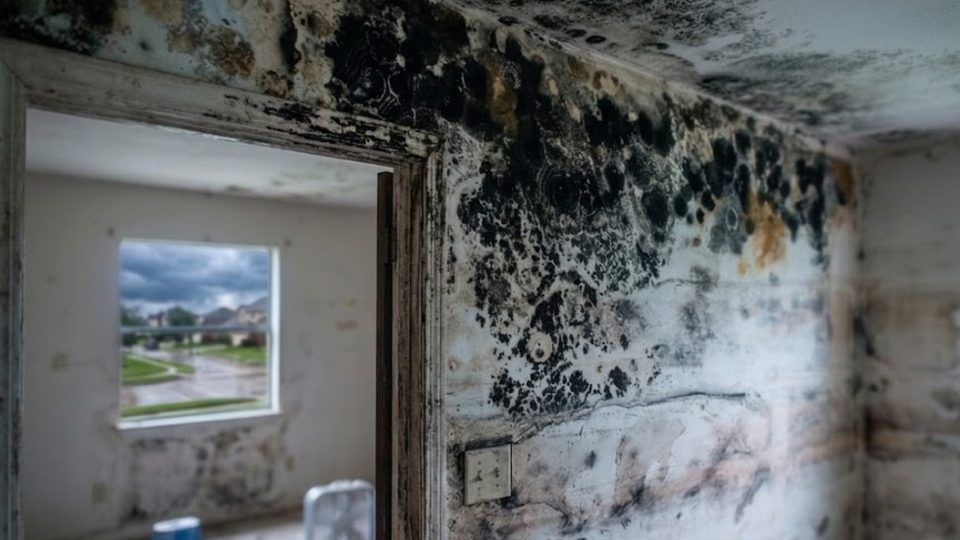
Nothing visible happens immediately. The ceiling looks normal. Then in June or July, as the house warms and the material finally begins to dry, the tannins and microbial staining migrate to the surface and a brown stain appears on an upstairs ceiling near an exterior wall.
The homeowner looks at the roof, in July, and finds nothing wrong — because there is nothing wrong with the roof. Roofers are called, a patch is applied somewhere, and the following spring it happens again.
If a ceiling stain appears in late spring or summer, near an exterior wall, in a room on the top floor, and you cannot find a roof defect above it — ask whether you had ice at the eaves last winter. Photographs from February on your phone are often the most useful diagnostic evidence available.
Reading the Evidence
| What you see | What it indicates |
|---|---|
| Icicles hanging from the gutters in winter | Not proof of a dam by itself, but proof that roof meltwater is refreezing at the eave — the same mechanism |
| A visible ridge of ice on the roof above the gutter line | An active ice dam |
| Snow melted in patches or stripes on the roof while neighbours' roofs stay covered | Heat loss through the ceiling plane, concentrated where the leaks are |
| Ceiling stain in spring or summer, near an exterior wall, top floor | Classic delayed ice dam damage |
| Staining on attic sheathing concentrated at the eaves | Ice dam water entry, as distinct from general condensation near the ridge |
| Paint blistering at the top of an exterior wall | Moisture in the wall cavity from above |
| Damp or compressed insulation at the attic perimeter | Water tracking in at the eave |
| Rot or staining at the rafter tails | Repeated ice dam cycles over several winters |
The Fix Is Air Sealing, Not Insulation Alone
This is where a great deal of money gets spent unproductively. Homeowners are commonly told to add insulation, and insulation does help — but it is the second half of the answer, not the first.
Heat moves into an attic by two routes: conduction through the ceiling material, which insulation slows, and air leakage through gaps, which insulation does almost nothing about. Blown-in insulation is air-permeable; warm air rises straight through it. Adding another foot of cellulose over a ceiling riddled with unsealed penetrations gives you a deeper layer of insulation with the same warm air flowing through it.
Air sealing first, then insulation. In that order.
- Seal every ceiling penetration. Recessed light housings (use fire-rated sealant and confirm the fixture is IC-rated before burying it), plumbing vent stacks, electrical wiring holes, bathroom fan housings, chimney chases with appropriate non-combustible material, and the top plates of interior walls, which are a continuous and usually forgotten gap.
- Insulate and weatherstrip the attic hatch. An uninsulated, unsealed hatch is one of the largest single air leaks in most houses, and it costs very little to fix.
- Then insulate to current depth, with baffles at the eaves maintaining a clear air channel from soffit to ridge.
- Make sure the soffit vents are actually open. Insulation blown in during a previous upgrade very commonly covers them. Blocked soffit intake means the ridge vent pulls air from inside the house instead of from outside, which makes everything worse.
- Ice and water membrane at the next roof replacement. A self-adhering membrane at the eaves — extending well beyond the interior wall line — does not prevent ice dams but does prevent the water from entering the structure when one forms. It is inexpensive as part of a re-roof and impossible to retrofit without one.
- Do not chip at the ice with anything. You will damage the shingles, and shingle damage in February is a considerably worse problem than the dam.
- Heat cables are a symptom treatment. They can keep a channel open in an emergency, but they consume electricity indefinitely, they fail, and they do nothing about the heat loss that caused the dam. They are a stopgap, not a solution.
- Do not get on the roof in winter. A roof rake used from the ground to pull snow off the lower three or four feet is genuinely useful and reasonably safe. Climbing onto an icy roof is not.
- Do not assume the roof is the problem. Replacing a sound roof because of ice dam damage is a common and expensive error. The roof did not fail; the ceiling plane did.
What to Do About the Mold Afterwards
If ice dam water has been entering for one or more winters, there is a reasonable chance of growth inside the wall cavity and above the ceiling. The material stayed wet inside a sealed assembly for weeks, which is exactly the sustained saturation that water-damage indicator organisms require.
Assessment means moisture metering along the top of the exterior wall and the ceiling in the affected rooms, thermal imaging to map the extent, attic inspection at the eaves and the rafter tails, and where readings are elevated, a borescope port into the wall cavity or the ceiling void. Remediation, if warranted, follows the standard sequence — but the essential point is that none of it lasts unless the air sealing is done. Remediate the ceiling, skip the air sealing, and you will be doing it again after the next hard winter.
Questions This Article Raises Most Often
As a stopgap on a roof you cannot yet fix, sometimes. As a solution, no. They keep a narrow channel open so meltwater can escape rather than pond behind the dam, which does prevent water entry in that channel. But they run on electricity all winter, they fail, they can shorten shingle life where they sit, and they do nothing whatsoever about the heat loss that is causing the dam. Spending the same money on air sealing the ceiling plane addresses the cause and reduces your heating bill at the same time.
General market ranges for this area: ceiling-plane air sealing alone, roughly $1,000 to $3,000 depending on how many penetrations there are and how accessible the attic is. Air sealing combined with topping up insulation to current depth, roughly $2,500 to $7,000. Adding soffit baffles and clearing blocked intake vents, roughly $800 to $2,000. Those are planning figures, not quotes. Utility energy-efficiency programmes in Pennsylvania sometimes offer rebates on air sealing and insulation, which is worth checking before you book.
A roof rake used from the ground to pull snow off the lower three or four feet of roof is genuinely useful and reasonably safe — it removes the snow that would otherwise melt and refreeze at the eave. Stand to the side rather than directly beneath, watch for the snow coming down, and stay well clear of power lines. What you should not do is climb onto an icy roof, or chip at the ice with anything: you will damage the shingles, and shingle damage in February is a considerably worse problem than the dam itself.
Because ice dams are caused by heat loss rather than weather, and heat loss varies house by house. Differences that matter: how well the ceiling plane is air-sealed, how much insulation is in the attic and whether it covers the eaves, whether the soffit vents are clear, whether there are recessed lights or an attic hatch leaking warm air, whether ductwork runs through the attic, and the roof pitch and eave overhang. Two identical-looking houses can behave completely differently. It also means the difference is fixable — it is not something you have to accept because of where you live.