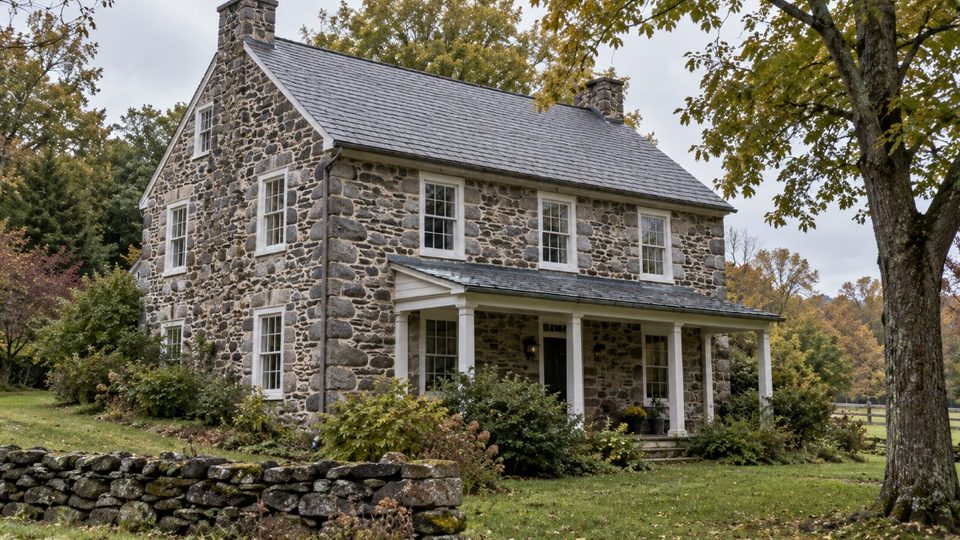
Large Old Houses, Large Old Problems
Villanova sits in Radnor Township in the 19085 ZIP, on the Main Line, and it is defined by the estate-era development of the late nineteenth and early twentieth centuries. Substantial stone houses on large lots, many built between roughly 1890 and 1930, alongside the Villanova University campus, some genuinely grand former estate properties, and later subdivision and infill.
Scale matters here in a way it does not in most housing. A large house has more roof, more flashing details, more plumbing, more wall area, more cellar and more unconditioned void space than a modest one — and every one of those is a place water can get in or condense. The mold problems in Villanova are rarely exotic. They are the ordinary problems of old buildings, multiplied.
Stone Construction and How It Was Meant to Work
The characteristic Villanova house is stone — local schist and fieldstone, often with substantial wall thicknesses, on stone foundations with no damp-proof course. Interior finishes were plaster on lath, frequently over masonry directly. The assembly was designed, insofar as it was designed at all, to be vapour-open: moisture entering the wall evaporated from the inside face, and lime mortar and lime plaster permitted that freely.
Two consequences follow. First, the cellars of these houses are permanently in capillary contact with the ground and always will be — a cool, slightly damp cellar with some efflorescence is normal behaviour for the building type, not a defect. Second, and more importantly, the damage almost always comes from modern attempts to make these walls behave like modern walls.
- Portland cement repointing. Harder and far less permeable than the stone. Moisture that once left through the soft lime joint is forced through the stone face, which spalls. Slow, cumulative, effectively irreversible.
- Interior waterproof coatings on cellar walls. Do not stop water entering. Stop it leaving. The water then blows the coating off or migrates to find another exit.
- Insulated stud walls against stone. Cold, dark, sealed, permanently damp cavity with fiberglass and paper-faced drywall in it. The worst concealed mold we find in Main Line houses is in exactly this assembly.
- Impermeable paint over lime plaster. Blistering paint on an old plaster wall is usually trapped moisture, not a paint failure.
The Other Recurring Sources
Concealed plumbing failures
As in Wayne and Strafford, original galvanised supply piping and cast-iron drain stacks are common and long past service life. In a large house with multiple bathrooms across several floors, there is a great deal more pipe to fail. A slow supply leak inside a plaster wall delivers the sustained saturation that water-damage indicator organisms need, and it can run for a very long time before anything is visible.
Roof complexity
Estate-era roofs have many planes, valleys, dormers, chimneys and often slate or tile coverings. Flashing details fail; slipped slates admit water; and water entering at a roof travels along rafters and emerges far from its entry point. These roofs also create numerous ice dam locations at valleys, low roof junctions and porch roofs, with damage that typically becomes visible the following summer.
Large unconditioned voids
Attics, third-floor spaces, service stairs, dumbwaiter shafts, and the voids around and behind finished attic rooms. Big houses have a lot of space nobody goes into. Warm air leaks in from heated rooms, condenses on cold surfaces, and nothing is observed for years.
Outbuildings, pool houses and carriage houses
A recurring blind spot. Secondary structures are frequently unheated or intermittently heated, poorly ventilated, and rarely inspected. Pool houses in particular combine high moisture load with intermittent conditioning — among the most reliable mold generators on a property.
Grounds and drainage
Large properties with mature landscaping, decades of regrading, retaining walls, terraces and hardscape frequently end up directing water toward buildings in ways nobody intended. Mature trees block gutters and lift drainage. This is far and away the cheapest thing to correct and one of the most commonly overlooked.
Conservation, Lead and Asbestos
Every pre-1940 house here is a pre-1978 building. Lead paint is likely; asbestos is common in pipe lagging, floor tile, mastic, textured finishes and duct wrap. Both need identifying before demolition rather than during it, and both carry obligations separate from the mold work.
There is also real value at stake in the fabric itself. Original plaster, millwork, flooring, stonework and windows are a substantial part of what these houses are worth, and remediation that treats the interior as disposable destroys value that cannot be recreated. Surgical removal, plaster repaired in plaster, masonry repaired in lime, and containment that genuinely protects adjacent finishes are the standard to hold contractors to. It is worth waiting for someone who has done this kind of work before.
What Assessment Should Cover
- Whole-property survey, not just the affected roomOn a large property the visible problem is frequently secondary to something elsewhere. Include outbuildings.
- Systems inventorySupply and drain materials by floor and wing, roof coverings and ages by plane, heating zones, and which spaces are conditioned and which are not.
- Moisture-map around every plumbing runHighest-yield survey in this housing stock.
- Read the cellar carefullyEfflorescence pattern, joist bearing points, anything furred out against stone, and whether any coating has been applied.
- Enter every voidAttics, third-floor cavities, service spaces, behind finished attic rooms.
- Survey the groundsGrading, hardscape drainage, downspout discharge, retaining walls and mature tree impact. Often the cheapest fix available.
- Test for lead and asbestos in advanceBefore any containment goes up.
What We Get Called About Most in Villanova
Ranked by how often it comes up, and tied to the buildings that are actually here rather than to mold in general.
- More plumbing, therefore more failuresA large house with several bathrooms across multiple floors simply contains more original pipe. The failure rate per metre is the same; the metres are not.
- Stone cellars sealed with modern coatingsCementitious waterproofing and impermeable paint on walls that stay sound by drying inward. The water does not stop entering — it stops leaving.
- Outbuildings nobody inspectsPool houses, carriage houses and garden buildings combine high moisture load with intermittent conditioning. Pool houses in particular are among the most reliable mold generators on a property.
- Grounds and drainage that have driftedDecades of regrading, mature planting, terraces and hardscape frequently end up directing water toward buildings in ways nobody intended. The cheapest fix available and the most overlooked.
- Large unconditioned voidsAttics, service stairs, third-floor spaces and shaft voids. Big houses have a lot of room that is never entered.
Neighborhoods and Sections We Cover in Villanova
Mold Services Available in Villanova
Mold Inspection
Thermal imaging and moisture metering to locate the source before anything is opened up.
DetailsBasement Mold Removal
The dominant mold problem in Villanova — finished walls, stone foundations and sump failures.
DetailsBlack Mold Removal
Full containment for water-damage indicator species, plus finding the sustained water source.
DetailsAttic Mold Removal
Sheathing and rafter growth traced back to ventilation, bath fans or ice damming.
DetailsWater Damage & Flood Mold
Burst pipes, sump failures and flooding — the 24 to 48 hour response window.
DetailsClearance Testing
Independent verification by a hygienist who did not perform the remediation.
DetailsWhat Mold Work Costs in Villanova
General market ranges for the Greater Philadelphia area, listed for the situations that actually come up in Villanova. These are planning figures rather than quotes — nobody can price a job they have not seen, and what moves a number most is the size of the wet area rather than the stained area. The full cost guide explains what drives each one up or down.
| Work | Typical range | Notes |
|---|---|---|
| Mold inspection with thermal imaging and moisture metering | $300–$700 | Most projects should start here |
| Small contained area — one wall section, a closet, behind a water heater | $600–$1,800 | Under roughly 10–30 sq ft |
| Historic stone cellar, lime-based repair | $4,000–$12,000 | Specialised materials; often less demolition |
| Single room | $1,500–$4,500 | Containment, removal, drying, clearance |
| Lead and asbestos testing before demolition (pre-1978 building) | $400–$1,200 | Far cheaper in advance than discovered mid-job |
| Independent post-remediation clearance testing | $350–$700 | The only stage that produces evidence rather than assurance |
| Reconstruction after remediation | $25–$60 / sq ft | Quote this separately so you can compare bids |
Mold FAQ — Villanova, PA
For a pre-1930 stone house, largely no — and that is a genuine answer rather than a brush-off. These foundations have no damp-proof course and are in permanent capillary contact with the ground. A cool, slightly damp cellar with some efflorescence on the stone is the building behaving as it was constructed to behave. What does need attention: standing water, visible fungal growth, a musty odour reaching the living floors, soft or eroding mortar, or dampness extending well up the wall. The strategy is exterior water management, keeping organic materials off the walls and floor, and mechanical dehumidification — not sealing, which is what breaks these buildings.
Not with a conventional insulated stud wall against the stone, which creates a cold, sealed, permanently damp cavity with cellulose in it. That assembly is responsible for the worst concealed mold we find in Main Line houses. If the space genuinely needs to be usable and insulated, the design has to keep the wall able to dry inward: no impermeable layers in contact with the masonry, no sealed cavities, moisture-tolerant materials, and permanent dehumidification. In many of these houses the better decision is to keep the cellar as a cool utility space, invest the money in exterior water management and drainage instead, and put the living space elsewhere. Get the moisture behaviour of the wall measured across a full summer before committing to any design.
Very probably, and it is one of the most commonly overlooked structures on a property like this. Pool houses combine a high moisture load — wet people, wet towels, often an indoor pool or a shower — with intermittent conditioning, since they are typically heated or cooled only when in use. That combination produces long periods where warm moist air sits against cool surfaces with no ventilation running. Changing rooms, the underside of roof decks, and any storage area are the usual locations. The same applies to carriage houses, garden buildings and unheated garages with rooms above. Include them in any whole-property assessment.
The range is genuinely wide here because the properties are. General planning figures: a whole-property inspection including outbuildings, roughly $600 to $1,500. A contained single-area remediation, roughly $2,000 to $6,000. A concealed plumbing leak that has saturated a wall assembly over an extended period, commonly $10,000 to $35,000, driven by the extent of the wet area and the cost of conservation-grade plaster repair. Cellar remediation with lime-based repair, roughly $6,000 to $20,000. Lead and asbestos testing before demolition, roughly $500 to $1,500. These are planning ranges only — a property of this type genuinely requires a site visit to scope.
Make it an explicit term of the scope of work rather than an assumption. Specify: protection method for floors, millwork and staircases; containment that isolates the work area without taping directly onto finished surfaces; surgical removal limited to the moisture-mapped extent with defined cut lines; plaster repaired in plaster rather than patched in drywall; lime mortar for any masonry repair; and a named person responsible for salvaging and reinstating any trim that must come off. Then ask for two or three addresses of comparable work you can look at. A contractor who has genuinely worked on this housing stock will have them readily; one who has not will change the subject to demolition scope.