The Clock Starts Immediately
A sump pump failure is the most common single emergency call in Montgomery County, and the reason it matters so much is that the consequences are governed by a genuine biological deadline rather than by how bad the water looks.
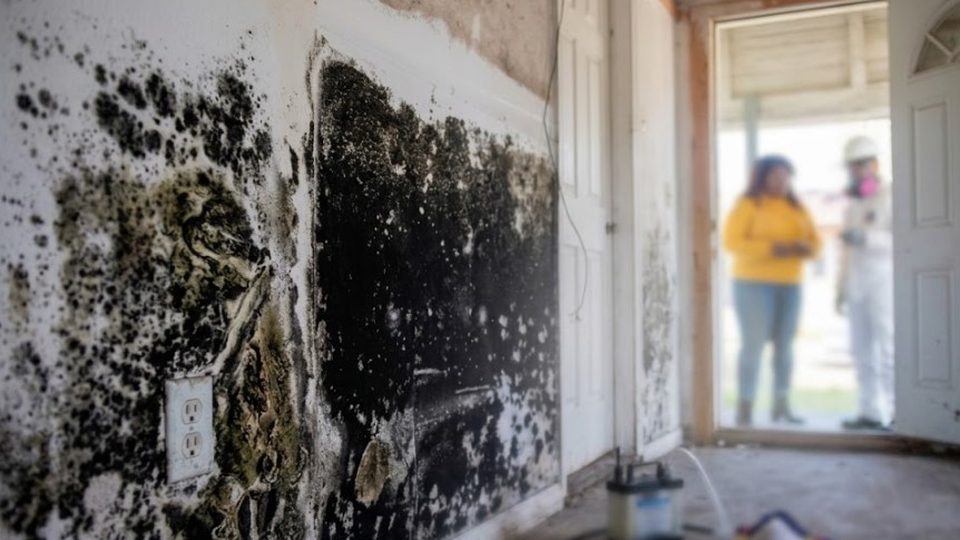
Mold colonies establish on wet cellulose material in roughly 24 to 48 hours at normal indoor temperatures. Visible growth typically appears in three to seven days. Drywall paper, carpet pad, fiberglass batt facing, cardboard and wood are all available substrate, and every one of them is present in a typical finished Montgomery County basement.
What that means in practice is that the same event has two entirely different outcomes, separated only by response time.
| Elapsed time | What is happening | What the job becomes |
|---|---|---|
| 0–6 hours | Water standing; carpet pad saturated; drywall wicking upward by capillary action; water running along the top of the slab under flooring | Extraction and drying. Most materials salvageable. |
| 6–24 hours | Wicking continues well above the visible line; insulation in wall cavities saturated; bottom plates absorbing; bacterial population in the water increasing | Extraction, controlled demolition to open cavities, structural drying. Pad out, carpet possibly saved. |
| 24–48 hours | Fungal germination on wet cellulose. Water degrading from Category 2 toward Category 3. | Drying plus antimicrobial treatment. More removal. Cost rising. |
| 3–7 days | Visible colonies. Musty odour established. Growth inside wall cavities where nobody can see it. | Now a mold remediation: containment, removal of porous materials, clearance testing. |
| Beyond a week | Established growth throughout the affected assemblies | Full remediation with significant demolition. Routinely two to four times the cost of the same event dried immediately. |
Sump Water Is Not Clean Water
Worth being clear about, because it affects what can be saved. Water from a sump pit is at best Category 2 — grey water. It has been sitting in a pit in contact with soil, it frequently contains groundwater that has passed through the ground around the foundation, and in many installations the pit also receives discharge from a perimeter drain.
Category 2 means carpet pad comes out without exception, carpet may be salvageable with proper cleaning, and drywall is assessed case by case. And Category 2 does not stay Category 2 — water standing at room temperature supports bacterial growth and degrades toward Category 3 within a couple of days. A basement discovered after a weekend away is not the same job as one discovered within an hour.
Why Pumps Fail, in Order of Frequency
- Power loss during the stormThe most common cause, and the most infuriating, because the pump is in perfect working order. In this region the power cut and the heavy rain arrive together — that is the same weather event. A mains-only pump is precisely useless at the moment it is most needed.
- Stuck float switchThe float jams against the pit wall, against the discharge pipe, or on debris. The pump never receives the signal to start. Tethered floats are more prone to this than vertical ones, particularly in a narrow pit.
- Failed check valveThe valve that stops the water in the discharge column running back down into the pit when the pump stops. When it fails, the pump empties the pit, the column drains back in, the pump starts again — and it short-cycles until the motor burns out. The tell is a pump that runs very frequently in brief bursts.
- Motor at end of lifeSump pumps are consumable. Typical service life is around seven to ten years, less with heavy duty cycles. A pump that has never been replaced in a fifteen-year-old house is overdue.
- Frozen or blocked discharge lineA discharge line that runs uphill, holds water, and freezes in January. Or one blocked by debris, ice, or a collapsed section. The pump runs, cannot move water, and overheats.
- Discharge too close to the houseNot a failure exactly, but a design fault with the same result. Water discharged three feet from the foundation soaks back down to the footing drain and returns to the pit. The pump runs continuously, pumping the same water in a circle until it fails from duty.
- Inflow exceeding capacityGenuinely undersized for an exceptional event. Less common than the others, but real in the extreme rainfall this region occasionally produces.
Three Changes That Prevent Most Failures
- A backup pump. Battery-powered with an automatic charger, or water-powered running off municipal supply pressure. Battery systems run for hours and need the battery replaced every few years; water-powered systems run indefinitely with no battery but need adequate municipal pressure and use potable water. Either addresses the single most common failure mode.
- Replace the check valve, and the pump if it is over eight years old. Both are inexpensive. A pump that fails is a pump that was going to fail at some point; the only question was whether it happened during a storm or during a scheduled replacement.
- Fix the discharge. Carry the water at least ten feet from the foundation, ideally to a location that drains away rather than back toward the house. Use rigid pipe rather than flexible corrugated, which sags and holds water. Where the line runs above ground, make sure it cannot freeze.
Two further inexpensive items worth having: a sealed pit cover, which cuts both the humidity entering the basement from the open pit and radon entry through the same route; and a water alarm on the floor near the pit, which costs very little and tells you about a failure while it is still a nuisance rather than a loss.
What to Do in the First Hour
- Make it safeCut power to the affected area at the breaker if water is anywhere near outlets, appliances or the panel. Do not stand in water to reach the breaker — if the panel is in the wet area, call the utility.
- Photograph and video everything before you move anythingWide shots for context, close shots for detail, and capture the water level on walls and furniture. Three minutes, and it is the most valuable thing you can do for a claim.
- Notify your insurer immediatelyEven if you are unsure whether it is covered. Prompt notice is a policy condition.
- Call for emergency extractionVolume removed mechanically is volume that does not have to be evaporated, which is the slow, expensive part.
- Lift what you safely canFurniture onto blocks or foil, rugs up off wet floors, documents and photographs out. Do not lift anything heavy and wet on your own.
- Do not use a household vacuumNot rated for water and an electrocution risk. A wet-dry shop vacuum is fine for small volumes.
- Do not just point fans at itAir movement without dehumidification evaporates the water out of the floor and deposits it into the drywall, the ceiling joists and the room next door. Drying requires both, and the dehumidification is the half that actually removes water from the building.
The Insurance Point Most People Miss
This is the one that costs Montgomery County homeowners real money, and it is worth checking before you need it.
Sump pump failure is typically excluded from a standard Pennsylvania homeowners policy. So is sewer backup. Both are widely available as an endorsement, usually for a modest annual premium, and in a county where sump failure is the commonest single cause of basement water, that endorsement is one of the better-value purchases available.
The second point: nearly every policy imposes a duty to mitigate — an obligation to take reasonable steps to prevent further damage after a loss. Waiting three days for an adjuster before starting to dry is not mitigation, and insurers routinely decline the additional damage that accrued in the interval. Photograph, notify, and start drying. In that order, in the first hour.
Questions This Article Raises Most Often
It depends on your water supply and how long your outages last. A battery system works anywhere, typically runs for several hours to a day of intermittent pumping, and needs the battery replaced every three to five years whether or not it has been used. A water-powered backup runs off municipal supply pressure, so it works indefinitely with no battery to maintain and no runtime limit — but it needs adequate municipal pressure, it uses potable water while running, it will not work on a well, and some municipalities restrict them. For a long outage the water-powered unit is stronger; for simplicity and universal fit, the battery.
Treat it as a consumable with a service life of roughly seven to ten years, less if it cycles frequently. A pump that has never been replaced in a fifteen-year-old house is overdue, and the failure will happen during a storm rather than on a convenient Tuesday. Test it a couple of times a year by pouring a bucket of water into the pit and confirming it starts, pumps and stops cleanly. A pump that short-cycles — starting and stopping repeatedly in quick bursts — usually has a failed check valve letting the discharge column run back into the pit, and that will burn the motor out.
Yes, because they solve different problems. The backup handles the failure; the alarm tells you the failure happened. Without one, a backup pump can quietly do its job for a week while the primary is dead, and you only discover it when the backup fails too. A basic water alarm on the floor near the pit costs very little; a connected one that messages your phone costs somewhat more and is genuinely useful if the property is ever empty for a few days. Put a second one near the water heater while you are at it.
It can be, and it can also be a fault. Continuous running in dry weather most often means a high water table, which is genuinely normal in low-lying parts of this county and near the river corridors — the pump is doing exactly what it is there for. But check two faults first, because both look identical: a failed check valve, which lets the discharge column drain back into the pit so the pump keeps re-pumping the same water; and a discharge line that ends too close to the house, so the water soaks back down to the footing drain and returns. Both are inexpensive to fix and both will destroy the pump.