What Actually Happened on 1 September 2021
The remnants of Hurricane Ida moved across southeastern Pennsylvania on the first of September 2021 and produced catastrophic flooding. The United States Geological Survey recorded new peak streamflows of record at numerous gauges across the region during that event. Along the Schuylkill, historic flooding damaged homes and businesses in the Norristown area and in neighbouring Bridgeport; bridges between the two boroughs were closed and flooding shut the Norristown Transportation Center. Record flooding also occurred along the Perkiomen Creek, which drains a large watershed through Collegeville before joining the Schuylkill near Oaks.
For context on the river itself: the Schuylkill gauge at Norristown has flood stage at 13 feet. Its all-time record crest is 25.10 feet, set during Hurricane Agnes in June 1972, with Hurricane Floyd bringing it to 22 feet in September 1999. Ida sits in that company — a genuinely exceptional event in a river valley that has seen several.
Five years on, we still take calls that trace back to that week. Not because the water is still there, but because of what happened next.
The Problem Was the Rush, Not the Water
When a region floods at that scale, every restoration contractor within fifty miles is booked within hours, and stays booked for months. Insurance adjusters are overwhelmed. Homeowners are desperate to get back into their houses. Under that pressure, a predictable set of corners gets cut — not maliciously, but systematically.
Here is what a properly executed post-flood job looks like, and what was frequently substituted for it.
| Stage | What should happen | What often happened in autumn 2021 |
|---|---|---|
| Water category assessment | Riverine floodwater is Category 3 — black water | Treated as clean water because it “came from the river, not the sewer” |
| Material removal | All contacted porous material removed: drywall, insulation, carpet, pad, cabinetry | Drywall cut at an arbitrary two feet; insulation left above the cut; cabinetry dried in place |
| Cavity drying | Wall cavities opened, dried to documented moisture targets, logged daily | Fans pointed at the room; equipment pulled on a schedule |
| Verification | Independent clearance testing before rebuilding | Skipped entirely on the overwhelming majority of jobs |
| Reconstruction | Rebuilt with assemblies suited to a flood-exposed property | Rebuilt exactly as before, over material that was never dried |
Why Category 3 Matters So Much Here
This is the single most important technical point about flood remediation, and it is the one most often glossed over.
Water is classified by contamination. Category 1 is clean water from a supply line or a water heater — most materials are salvageable if dried fast. Category 2 is grey water from appliance discharge or a sump pit. Category 3 is black water: sewage, river flooding, or any water that has been standing long enough to develop a biological population.
Riverine floodwater is unambiguously Category 3. It has passed over roads and parking lots, through storm drains, past fuel storage, over agricultural land, and in a great many combined-sewer situations through sanitary systems as well. It carries bacteria, chemical contaminants and organic material into every porous thing it touches.
The standard of care for Category 3 is not negotiable: all porous material that the water contacted is removed. Not dried, not cleaned, not treated with a biocide. Removed and disposed of. Drywall, fiberglass insulation, carpet and pad, particleboard cabinetry, ceiling tile, and any upholstered item that absorbed it.
You will often hear that drywall is cut “two feet above the water line”. That is a rule of thumb, not a standard. Water wicks up gypsum board by capillary action well beyond the visible line, and insulation behind the wall wicks further still. The correct cut line is determined by moisture mapping — metering the wall and cutting back beyond the last elevated reading, typically twelve to twenty-four inches past it. In many Ida jobs the cut was two feet because two feet is what people say, and the material above it was wet.
How to Tell Whether Your House Is Still Carrying It
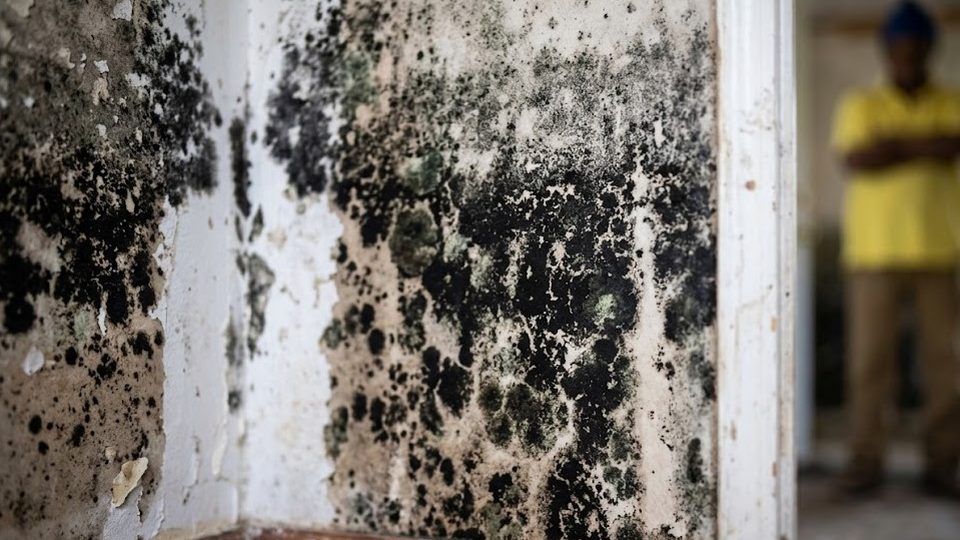
Mold from a 2021 flood does not announce itself. If it were visible you would have dealt with it. What you are looking for is indirect evidence.
- Persistent musty odour, especially when the space has been shut upMicrobial volatile organic compounds are produced by living colonies. A musty smell is not a residue of an old event — it means something is actively growing right now. This is the strongest single indicator.
- A wavy or bulging line at the base of the drywallGypsum board that took on water and dried in place deforms. A subtle horizontal undulation near the floor, or baseboard that no longer sits flat against the wall, points to material that was wet and was not replaced.
- Soft or spongy baseboard, or trim that has separatedPress firmly along the bottom of the baseboard with a thumb. It should be rigid.
- Staining that reappears after paintingTannin and microbial staining bleeding through fresh paint indicates continuing moisture or residual contamination behind it.
- Rust on fixings, hinges and electrical boxes near floor levelCorrosion is a slow integrator — it tells you the area has been humid for a long time.
- Symptoms that improve when you leave the houseNot diagnostic on its own, and a matter for a physician rather than a contractor, but a pattern worth noticing alongside the physical evidence.
- No clearance report in your paperworkGo and look. If your file from 2021 contains an invoice and nothing else — no moisture readings, no drying log, no independent clearance test — then nobody ever verified that the job worked.
What an Investigation Involves Now
Five years after the event, the diagnostic approach is different from a fresh water loss. The water is long gone; what you are looking for is whether material inside the assemblies was ever dried and whether growth established.
Moisture metering along the base of every wall that was in the flood zone. Elevated readings this long afterwards indicate an ongoing source rather than residual flood water — but normal readings do not clear the wall, because material can be dry now and still carry established colonies from 2021.
Thermal imaging to identify anomalies and, importantly, to map where insulation is missing or compressed, which often marks where material was removed and where it was not.
Cavity air sampling. This is the technique that actually answers the question. A small port is made in the drywall and the sampling probe inserted into the wall cavity itself, so the air inside the assembly is sampled rather than the air in the room. A room sample can read normal while the cavity behind the wall is heavily contaminated, because the wall is substantially sealed from the room.
Borescope inspection through the same port, to look directly at the back of the drywall and the condition of any insulation left in place.
If You Are Thinking of Selling
This deserves its own section because it is where the cost of an unresolved 2021 flood usually lands.
Pennsylvania’s Real Estate Seller Disclosure Law requires disclosure of known material defects, and the standard form covers water infiltration in basements and crawl spaces and known mold. A flood in September 2021 is a known material fact about the property. The question a buyer will ask — and their inspector will investigate — is what was done about it.
“It flooded in Ida, here is the inspection report, the scope of work and the independent clearance test” is a conversation that closes. “It flooded in Ida and someone came and dried it out” is a conversation that produces a price reduction three days before settlement, at a number the buyer chooses. Resolving and documenting it while you have time is considerably cheaper.
Preparing for the Next One
There will be another. This river valley has produced Agnes in 1972, Floyd in 1999 and Ida in 2021, among others. If you own property in the exposed areas of Norristown, Bridgeport, Conshohocken, Collegeville or Royersford, preparation is worth more than response.
- Flood insurance. Standard homeowners policies exclude surface flooding entirely. NFIP coverage is separate and is the only thing that responds to a river event. Check whether your property is in a mapped flood zone — and note that a meaningful share of Ida damage occurred outside mapped zones.
- Sump backup. Battery or water-powered. A mains pump does nothing in a power cut, and the outage and the storm arrive together.
- Do not finish a basement in the flood zone conventionally. If the space must be finished, use materials that survive wetting — closed-cell foam rather than fiberglass, cement board or paperless gypsum rather than paper-faced, sealed concrete or tile rather than carpet, and no particleboard cabinetry at floor level.
- Nothing irreplaceable below grade. Documents, photographs, instruments. The cost of a waterproof case is trivial against what people lost in 2021.
- Know where your shut-offs are — water main and electrical panel — before you need them in the dark.
- Photograph your basement now, in good condition. Before-and-after documentation is worth a great deal on a claim.
- Make it safe — power off to affected areas at the breaker, and do not stand in water to reach it
- Photograph and video everything before moving anything
- Notify your insurer immediately, even if you are unsure of coverage
- Call for emergency extraction and drying at once — nearly every policy imposes a duty to mitigate, so waiting for the adjuster is not compliance, it is a gap in your claim
- Do not run fans without dehumidification; that moves the water into other materials rather than out of the building
Questions This Article Raises Most Often
Several routes, and it is worth using more than one. Ask the seller directly and in writing — under Pennsylvania's disclosure law they must disclose known material defects, and a flood is one. Check the FEMA flood map for the parcel. Ask neighbours, who will remember. Look for the physical evidence yourself: a horizontal tide line on unpainted foundation masonry, replacement drywall that stops at an arbitrary height, mismatched or newer-looking joists or subfloor in one area, newer electrical outlets low on a wall, or a furnace and water heater noticeably newer than the rest of the house. And check the municipality — Norristown, Bridgeport and Conshohocken all issued large numbers of permits in late 2021, and permit records are public.
Almost certainly not under that claim, and this is where people are caught out. Policies have time limits for reopening a claim, and more fundamentally, surface flooding is excluded from standard homeowners cover entirely — if you were paid in 2021 it was probably through NFIP flood cover, which has its own proof-of-loss deadlines. Mold discovered years later is also very difficult to attribute to a specific covered event rather than to ongoing conditions. It is still worth calling your carrier and asking, and keeping the original claim file, but plan on the basis that this is likely an out-of-pocket repair.
It depends entirely on whether the framing and the insulation behind it were dried to target before the new board went on. If the contractor cut at two feet, left the insulation above the cut in place, and closed it up within a couple of days, then wet material is now sealed inside the wall. The way to check without demolition is moisture metering along the wall, a thermal scan, and a borescope port placed low where a baseboard covers the repair. That is a pencil-diameter hole, not a demolition job.
Not a hard one, but two soft ones worth knowing. If you intend to sell, resolve and document it beforehand — discovering it through a buyer's inspector eleven days before settlement costs far more than fixing it on your own timetable. And if anyone in the household has asthma or is immunocompromised, the case for investigating sooner is stronger. Otherwise the material is not getting dramatically worse year on year; it is simply not getting better either.