The Hierarchy That Works
Indoor air quality is a broad field — particulates, volatile organic compounds, combustion byproducts, carbon dioxide, radon. In King of Prussia housing, the thread running through most of what people actually complain about is moisture.
Which gives a clear order of operations:
- Control the moisture sourceEverything else is secondary. A filter cleans air; it does not dry a wall.
- Ventilate — and verify it goes outsideRemoving moisture and pollutants at source, before they disperse through the house.
- FilterGenuinely useful, and third in line. Most households are sold this step first.
That inversion — buying an air purifier before fixing the damp basement — is the single most common wasted expenditure in home air quality, and it is why so many people own an expensive machine and still have a musty house.
The Number That Matters Most
Indoor relative humidity is the most useful measurement a homeowner can take, and a decent hygrometer costs less than a takeaway meal.
| Indoor RH | What happens |
|---|---|
| Below 30% | Dry mucous membranes, static, shrinking woodwork, cracking plaster. Common in a tightly heated house in January. |
| 30–50% | The target. Mold suppressed, dust mite populations collapse, comfort best. |
| 50–60% | Dust mites thrive. Growth begins on any surface cooler than the room. |
| Above 60% | Sustained growth on most organic surfaces. Typical of an unconditioned local basement, June to September. |
A basement at 55% RH and 72°F has a dew point of roughly 55°F. If the foundation wall is at 54°F — entirely normal for buried masonry here — that wall is condensing continuously, despite a reading that looks acceptable. Mold grows at surfaces, not in the middle of the room.
Two Seasons, Two Different Jobs
Summer is a dehumidification problem. Regional dew points sit in the mid-60s to low 70s°F for weeks. Every cubic foot of outdoor air brought into a basement deposits water on cold surfaces. Close the basement to outdoor air and dehumidify mechanically — correctly sized, plumbed to a drain, set to 45–50%. Opening the windows on a humid July day adds more water than it removes.
Winter is an air-sealing and ventilation problem. Cold air holds little moisture, so infiltration dries the house out. The risk moves inside the assemblies: warm indoor air pushes outward and condenses on cold sheathing and roof decking. The work is air sealing at the ceiling plane, verifying exhausts terminate outdoors, and in very tight homes providing balanced mechanical ventilation. Running a humidifier hard in a leaky older house in January can push enough moisture into the walls to cause the problem you are trying to avoid.
And the shoulder seasons. April, May and October — heating off, cooling off, nothing controlling humidity. Mild, damp, still weather with no dehumidification is when a surprising amount of spring growth begins here, particularly where the dehumidifier was unplugged in November and not restarted until June.
Ventilation: What Most Homes Get Wrong
- Bathroom exhaust. Must move enough air (roughly 50 CFM minimum), must terminate outside through the roof or a gable, and must run about twenty minutes after the shower — which realistically means a timer switch. A fan discharging into the attic is among the most common attic mold causes in this housing stock. Go and check yours.
- Kitchen exhaust. A recirculating hood filters grease and returns all the moisture to the room. Only a ducted hood removes water vapour.
- Dryer venting. Several litres of water per load. A disconnected duct puts all of it into the building, and it is a fire risk besides.
- Combustion safety. If you air-seal a basement aggressively and there is an atmospherically vented furnace or water heater, have the venting checked. This is a carbon monoxide question.
- Balanced ventilation in tight new construction. Homes in KOP Town Center, the Village at Valley Forge and Eagleview leak very little air by design. Without a working ERV or HRV, interior moisture accumulates. A humidity complaint in a five-year-old home is a ventilation deficit, not a defect.
Filtration: Useful, Third in Line
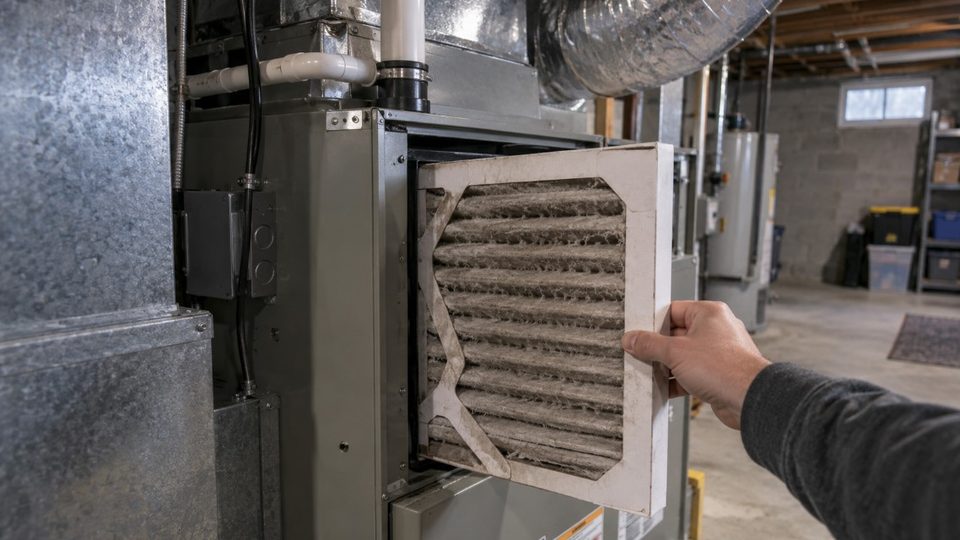
- HVAC filter. MERV 11 to 13 pleated captures a meaningful fraction of spores and fine particulate. Going higher without checking the system’s static pressure tolerance restricts airflow, which can freeze the coil and create a condensation problem — genuinely counterproductive.
- Portable HEPA units. Effective in the room they occupy. Useful for a bedroom during remediation or for an allergic occupant. They do nothing for the rest of the house.
- UV-C at the coil. Reasonable evidence that a correctly positioned lamp keeps the evaporator coil and drain pan free of biofilm — a real benefit in a humid climate. Claims about sterilising air passing through the duct are much weaker; contact time at duct velocity is a fraction of a second.
- Ozone generators. Avoid in occupied spaces. Ozone is a lung irritant and the EPA does not recommend these devices for indoor air cleaning.
Do Not Forget Radon
Montgomery and Chester Counties sit in an area of elevated radon potential, and roughly 40 percent of Pennsylvania homes tested exceed the EPA action level of 4 pCi/L. Radon and moisture share entry pathways through the slab joint, cracks and the sump pit. It is a separate problem requiring separate testing, and unlike mold it is regulated here — the DEP certifies testers and mitigators, so there is an actual credential to check. A short-term test kit costs very little. See radon and mold.
- Hygrometer in the basement and one upstairs. Read them for a few weeks in different weather.
- Gutters clear, downspouts discharging six feet or more out, grading falling away.
- Physically verify every exhaust termination — bath fans, kitchen hood, dryer.
- Dehumidifier in the basement, correctly sized, plumbed to a drain, 45–50%, April to October.
- Air-seal and insulate the rim joist; insulate cold water lines.
- MERV 11–13 in the HVAC, changed on schedule. Portable HEPA where a room needs it.
- Radon test kit.
Questions This Article Raises Most Often
An inexpensive digital hygrometer is adequate — you are looking for trends rather than laboratory precision. Place one in the basement about a metre off the floor and away from the dehumidifier, and one on the main living floor away from the kitchen, bathrooms and any exterior door. Read them across a few weeks in different weather rather than taking a single reading. If you want to be more rigorous, a second unit placed on a shelf against an exterior wall will show you how much colder and damper that microclimate is than the middle of the room.
It captures airborne spores in the room it occupies, which is genuinely useful for symptom relief — a bedroom during remediation, or for an occupant with allergies. What it does not do is dry a wet surface, and a musty smell is produced by active growth on a damp material rather than by particles in the air. So a purifier reduces the symptom while the cause continues. Use one if it helps you sleep; do not let it substitute for finding the moisture. Size by the room's air changes per hour rather than by the marketing claim.
Used carefully, and with a limit. Winter air in this region is genuinely dry and some humidification improves comfort and reduces static and woodwork shrinkage. The risk is overdoing it: pushing indoor humidity much above 40 percent in a Pennsylvania winter drives moisture into cold wall and roof assemblies where it condenses out of sight, which is how a comfort measure becomes a concealed mold problem. Keep a hygrometer, set the humidistat rather than the dial, and reduce the setting further as the outdoor temperature drops.
More often than most households do. A 1-inch pleated filter in a system that runs regularly typically needs changing every one to three months; households with pets, smokers or ongoing construction are at the short end. Thicker 4- or 5-inch media filters commonly last six to twelve months. The practical test is to look at it against a light: if you cannot see light through it, it has been restricting airflow for a while. A loaded filter both bypasses dirt onto the evaporator coil and restricts airflow enough to promote coil freezing, which creates its own moisture problem.