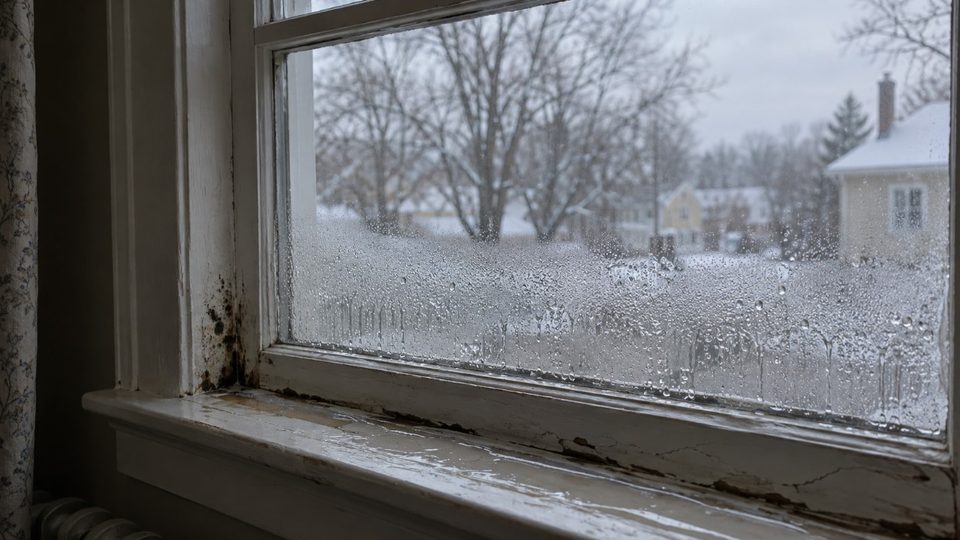
Why Your Windows Run With Water in January
Window condensation is the most visible moisture problem in a Pennsylvania house and the most consistently misread. People assume the windows are faulty. Usually they are not — the windows are simply the coldest interior surface in the room, and they are showing you something true about the whole house.
The mechanism is the same one that produces basement condensation in summer, running in the opposite direction. Indoor air in winter carries moisture from cooking, showering, laundry, houseplants and breathing. Glass and especially metal or aluminium-framed windows sit far colder than the room — on a 20°F night, the inner face of a single-glazed pane can be close to freezing. When room air contacts a surface below its dew point, it releases liquid water onto it.
The window is a dew point meter you already own. If it is streaming, your indoor humidity is too high for the coldest surfaces in your building — and the windows are merely where you can see it happening. The same condensation is occurring, invisibly, on other cold surfaces: behind furniture against exterior walls, inside closets on outside walls, at uninsulated corners, and within wall cavities where warm air reaches cold sheathing.
Where It Becomes Mold
- The sill and the frameWater runs down the glass and pools on the sill. Painted wooden sills soften, paint blisters, and growth establishes in the joint between sill and frame. This is the visible tier and the easiest to address.
- The wall immediately belowPersistent run-off soaks into the drywall or plaster under the window. Staining, a wavy line and eventually soft board.
- The reveal and the cornersWindow openings are thermal bridges — the framing around them conducts cold inward. The corners of the reveal are frequently the coldest interior surface in the entire room, and the first place growth appears.
- Behind curtains and blindsA closed curtain traps a pocket of cold, still, humid air against the glass and the reveal. Growth behind heavy curtains in a north-facing bedroom is extremely common and entirely invisible until you pull them back.
- Inside the wall below the sillWhere run-off has been happening for years, water tracks into the cavity. This is the tier where a cosmetic complaint becomes a remediation.
Condensation Between the Panes Is a Different Problem
Worth separating, because the fix is entirely different. Fogging or moisture between the panes of a double-glazed unit means the hermetic seal has failed and the insulating gas has escaped. That is a failed unit, not a humidity problem, and no amount of ventilation or dehumidification will change it. The sealed unit needs replacing — frequently possible without replacing the whole window. It also means that pane is now performing far worse thermally than it should, so the surface is colder and condensation on the room side gets worse too.
What Actually Fixes It
Two levers, and you generally need both: lower the indoor humidity, and raise the surface temperature.
Lower the humidity
- Extract at source. Bathroom fan running twenty minutes after every shower — which realistically means a timer switch. Kitchen hood ducted outside, not recirculating. Both are the largest moisture sources in most homes.
- Check the dryer. A clothes dryer discharges several litres per load. A disconnected or crushed duct puts all of it into the house, and it is a fire risk besides.
- Stop drying laundry indoors, or at least do it in a room with the extractor running.
- Turn the humidifier down. If you run a whole-house humidifier, this is frequently the entire cause. Target 30–40% in deep winter and reduce further as outdoor temperatures drop.
- Measure it. A hygrometer costs less than a takeaway. Sustained readings above 45% in January mean the moisture load is too high for the building.
Raise the surface temperature
- Let air reach the glass. Open curtains and blinds during the day; leave a gap at the bottom of heavy curtains overnight. Move furniture a few inches off exterior walls so air can circulate behind it.
- Warm the room rather than letting it drop. An unheated spare bedroom with the door closed is where condensation is worst, because its surfaces are coldest and its air still receives moisture from the rest of the house.
- Upgrade the glazing where it makes sense. Double glazing with a warm-edge spacer raises the inner surface temperature substantially. Secondary glazing achieves much of the same at lower cost on historic windows that should not be replaced.
- Insulate the reveal. Where the framing around an opening is bridging cold inward, insulating the reveal during any window work removes the coldest spot in the room.
- Sealing the room up completely. Draught-proofing without providing any ventilation raises the indoor humidity and moves the condensation from the window — where you can see it and wipe it — into the wall cavity, where you cannot.
- Unvented portable gas or paraffin heaters. These produce roughly a litre of water vapour for every litre of fuel burned, directly into the room. In a house with a condensation problem they are close to the worst possible heat source.
Historic Windows on the Main Line
A specific case worth its own note, because the standard advice is wrong for these buildings.
Original single-glazed sash windows in Wayne, Strafford, Villanova and the older boroughs condense heavily, and the instinctive response — replace them with sealed modern units — is often both expensive and detrimental to the building. These windows are frequently in better condition than they look, repairable indefinitely, and part of what makes the property valuable.
The approaches that work: draught-proofing the sashes properly, which reduces the cold air movement without sealing the building; secondary glazing on the room side, which raises the inner surface temperature markedly and is reversible; heavy but well-managed curtains that are opened during the day; and getting the whole-house humidity down so that the glass, cold as it is, stays above the dew point. Maintaining a slightly lower indoor humidity is the price of keeping original windows, and in a house of that quality it is usually the right trade.
And the Opposite Case: Condensation in a New House
Condensation on the windows of a five-year-old townhome is not a defect in the glazing — the glazing is the best part of the building. It is a ventilation deficit. Modern envelopes leak very little air by design, so household moisture accumulates unless it is removed mechanically. Check whether the home has an ERV or HRV and whether it is switched on with a clean filter; check that bathroom and kitchen extraction is adequate and actually used; and put a hygrometer in the living space. Sustained readings above 50% in winter confirm it. The fix is mechanical and inexpensive.
Questions This Article Raises Most Often
Usually the opposite. Condensation on the room-side face of the glass means the glass is the coldest surface in the room and your indoor humidity is above its dew point — which is information about the air in your house, not a defect in the window. The case where the window genuinely is at fault is fogging between the panes of a double-glazed unit: that means the hermetic seal has failed, the insulating gas has escaped, and the sealed unit needs replacing.
A little misting on the coldest mornings, clearing as the day warms, is unremarkable in most houses here. What is not normal is water running down the glass and pooling on the sill, condensation that persists all day, or moisture appearing on the frames and reveals as well as the glass. A useful rule: if you are wiping sills regularly, the indoor humidity is high enough that the same condensation is occurring on cold surfaces you cannot see — inside wall cavities, behind furniture and in exterior-wall closets.
It will reduce it, and in a house with a genuinely high moisture load it can resolve it. But in winter the more effective and cheaper levers are usually extraction at source — running the bathroom fan properly, ducting the kitchen hood outside, checking the dryer duct — and turning down any whole-house humidifier, which is frequently the entire cause. A dehumidifier running in a cold room also works less efficiently than it does in a warm basement in summer. Measure with a hygrometer first and see how high the humidity actually is.
It will help, and on a historic property it is often neither necessary nor desirable. Original sash windows in Wayne, Strafford, Villanova and the older boroughs are frequently repairable indefinitely and are part of what makes the house valuable; replacing them is expensive and irreversible. The alternatives that work: draught-proofing the sashes, secondary glazing on the room side — which raises the inner surface temperature markedly and can be removed — and getting the whole-house humidity down so the glass stays above the dew point despite being cold.