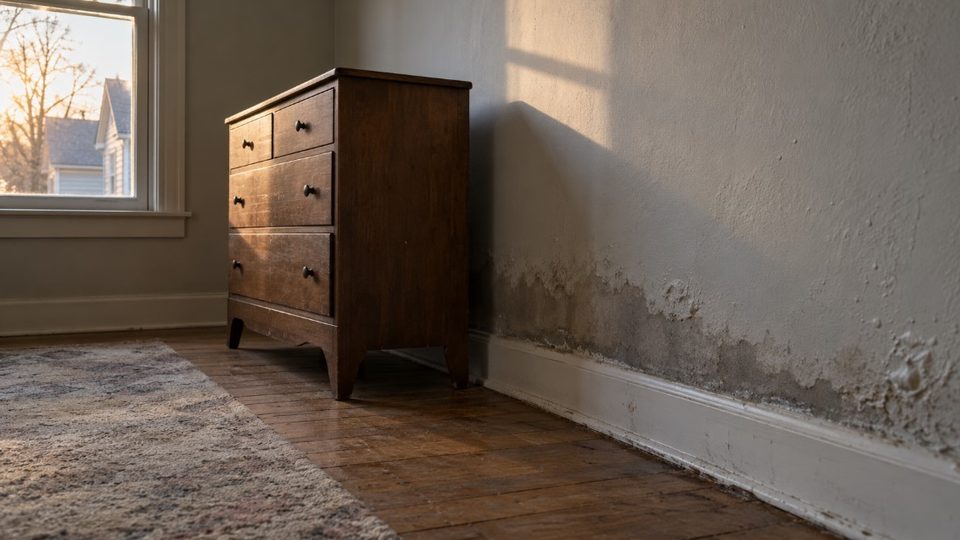
Why Masonry Transmits Moisture Between Homes
In a twin or a rowhome, you and your neighbour share a structural wall. In the older stock of Norristown, Bridgeport, Conshohocken, Lansdale and Royersford, that wall is typically brick or stone, and it is continuous from the footing to the roof.
Masonry is porous. Water moves through it by capillary action, and it does not recognise the property line. If the cellar on the other side of that wall is chronically wet — because a downspout discharges against the foundation, because the grading has settled, because nobody has run a dehumidifier in fifteen years, because the property is vacant — then water is moving into the shared masonry and emerging on your side.
Three routes in particular:
- Through the wall laterally. Water in the masonry moves toward the drier face, which is yours if you are managing your side and they are not.
- Up through the shared footing. Capillary rise does not stop at a property boundary either. A neighbour whose exterior drainage soaks the footing is soaking your footing too.
- Through gaps at the top. In the attic and roof space, party walls frequently do not extend cleanly to the roof deck, and older ones are often unsealed. Air — and with it moisture and spores — passes between the properties in the roof space more freely than most owners realise.
If the source is on the other side of the wall, remediating your side removes the growth and does not remove the water. It will come back, usually within a season, and you will have paid for it. This is why the first step in a suspected party wall case is not a contractor — it is documentation.
How to Tell Whether the Source Is Next Door
The evidence is a gradient. Moisture readings taken systematically across the affected area should be highest nearest the party wall and fall off as you move away from it. That pattern is not consistent with a source on your own side, and it is the single most useful measurement in these cases.
- Moisture-map the whole cellar, not just the wet bitReadings on a grid across the party wall and across your exterior walls. Note the numbers and where they were taken. You want to be able to show that the wet zone centres on the shared wall.
- Thermal scan the party wallLooks for cold plumes and patterns that suggest water movement through the masonry from the far side.
- Rule out your own side properlyThis matters for credibility as much as for accuracy. Check your gutters, your downspout discharge, your grading, your sump. If you approach a neighbour with a complaint and they can point at your overflowing gutter, the conversation is over.
- Look at the exterior of both propertiesDownspout discharge points, grading, pointing condition, window wells, and whether the neighbouring property shows signs of neglect. Photograph from the public side only.
- Check the roof spaceLook at the party wall where it meets the roof. Is it sealed? Can you see through into the adjoining property? Is there staining on your side near the shared wall?
- Get it into a written reportAn independent inspection with numeric readings, photographs and a stated conclusion. This is what turns “I think it is your fault” into a document.
Approaching the Neighbour
How this goes depends almost entirely on who owns the other side, and it is worth thinking about before you knock on the door.
Owner-occupied
Usually the easiest, if handled well. In the great majority of cases the neighbour does not know. A wet cellar that has been wet for twenty years is normal to the person living with it, and they have no idea it is affecting you.
Lead with the report rather than the accusation. “We had an inspection done and it found the moisture is coming through the shared wall — I wanted to show you what they found, because it probably means you have the same problem” is an opening that works. “Your damp is getting into my house” is an opening that closes. Frequently the fix is a downspout extension and costs almost nothing, and framing it as a shared problem gets it done.
A rental property
Different route. The tenants are not responsible for the building and often have no power to act, but they do have standing. Pennsylvania’s implied warranty of habitability requires a landlord to keep a rental fit for human habitation, and a chronically wet cellar affecting the unit is a habitability matter. A tenant giving written notice to their landlord carries considerably more weight than a neighbour doing so.
Approach the tenants first, with the report. In our experience they are often relieved — they have usually been complaining about the damp themselves. If that goes nowhere, write to the landlord directly, and keep a copy.
Vacant, absentee or bank-owned
The hardest case and the most common source of serious problems. Nobody is running a dehumidifier, nobody notices a burst pipe, and a vacant property with no heat through a winter can develop severe moisture problems very quickly.
Here the route is municipal code enforcement. Norristown, Bridgeport, Conshohocken, Lansdale and Royersford all have code enforcement offices with authority over property maintenance, and a documented report of a condition affecting an adjoining property is exactly the kind of complaint they act on. Be factual, provide the inspection report, and follow up in writing.
If nothing works
Pennsylvania law recognises causes of action relating to a property owner whose condition damages a neighbouring property, and there are legal routes available. That is a conversation for a Pennsylvania attorney, not for us, and nothing in this article is legal advice. What we can say usefully is that any such route depends entirely on documentation created early — dated photographs, an independent inspection with readings, and a written record of every attempt you made to resolve it informally.
What to Do on Your Side Meanwhile
You are not powerless while this plays out, and some of these help substantially.
- Perfect your own exterior water management. Gutters, downspouts well away, grading. It reduces the total water load at the shared footing and it removes any argument about your own contribution.
- Run a dehumidifier continuously. Correctly sized, plumbed to a drain, set to 45–50%. This does not stop water entering the masonry but it does keep the interior air dry enough to prevent growth on surfaces, which is where the actual harm is.
- Get everything organic off the party wall and off the floor. No shelving against it, no cardboard, no stored textiles. If the wall is going to be damp, make sure there is nothing on it to grow.
- Do not seal the party wall. The instinct to apply a waterproof coating to the inside face is strong and it is wrong for exactly the reasons it is wrong on any masonry — you block the exit, not the entrance, and the water finds another way out or spalls the brick.
- Improve air movement. A small fan keeping air moving along the wall prevents the still, saturated boundary layer where growth establishes.
- Seal the party wall in the roof space. This one you can do unilaterally, and it stops air, moisture and spores moving between the properties at roof level. It is also a fire separation improvement.
If You Are Buying a Twin or Rowhome
Look at the neighbouring property, deliberately and before you commit. Is it occupied and maintained? Are its gutters intact and its downspouts discharging away from the building? Is the pointing sound? Is it obviously vacant?
The condition of the house attached to the one you are buying is a material factor in the moisture behaviour of your own cellar, and it is not something a standard home inspection will comment on. Ask the seller directly whether there has ever been damp on the party wall, and have your inspector take moisture readings along it specifically.
Questions This Article Raises Most Often
Possibly, and it depends on the deed and on who caused the problem. Party walls in Pennsylvania are commonly subject to rights and obligations recorded in the deeds or arising from long use, and shared structural elements often carry shared maintenance responsibility. Where the damage results from one owner's neglect — a failed downspout, an untreated cellar — the position is different from ordinary shared wear. Have a Pennsylvania real estate attorney read the deeds before you either pay or refuse, because the answer is property-specific and an early informal agreement is usually cheaper than establishing who was right.
Municipal code enforcement is the route, and it is more effective than owners expect. Norristown, Bridgeport, Conshohocken, Lansdale and Royersford all have code offices with authority over property maintenance, and a documented condition affecting an adjoining property is exactly the sort of complaint they act on. Provide the inspection report rather than just a phone call, follow up in writing, and keep a record of every contact. Where a property is bank-owned, the servicer usually has a property preservation contractor, and code enforcement knows how to reach them.
Do not, and this is one of the more common expensive mistakes. Applying a waterproof coating to the inside face of a masonry party wall blocks the exit rather than the entrance: water still arrives from the other side, and once it cannot evaporate it accumulates, blows the coating off, or emerges higher up and spalls the brick. The things that genuinely help on your side are keeping the wall clear of stored material and shelving, maintaining air movement along it, running a dehumidifier, and sealing the wall where it meets the roof space — which stops air, moisture and spores passing at that level.
With a moisture gradient. Readings taken systematically on a grid should be highest at the party wall and fall off as you move away from it — a pattern that is not consistent with a source on your own side. Before presenting that, rule out your own contributions properly: gutters, downspout discharge, grading, and your sump. That matters for credibility as much as for accuracy, because if you approach a neighbour and they can point at your overflowing gutter, the conversation ends there.